The Lone Star State
Birding in Texas
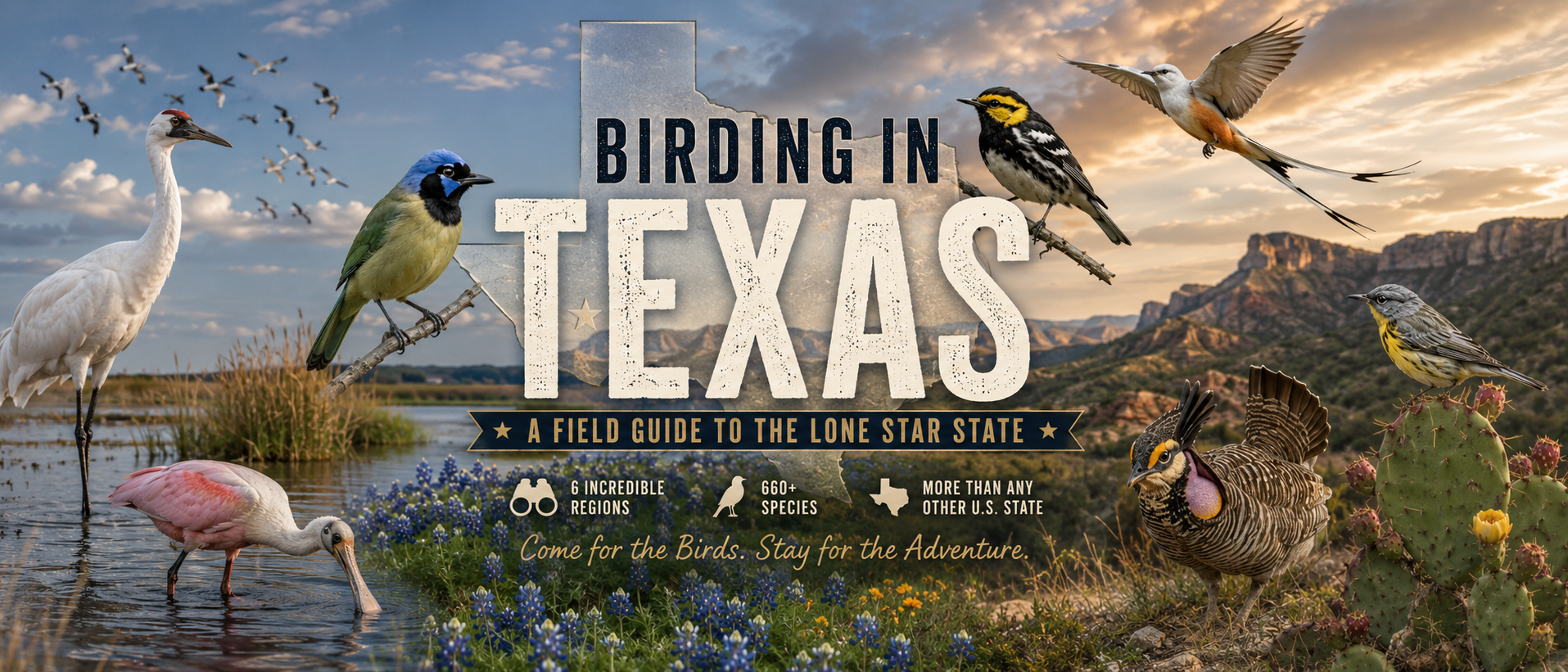
660+ species. 6 incredible regions. More birds than any other U.S. state — from Whooping Cranes on the Gulf Coast to Colima Warblers in the Big Bend mountains.
Why Texas? The Migration Math
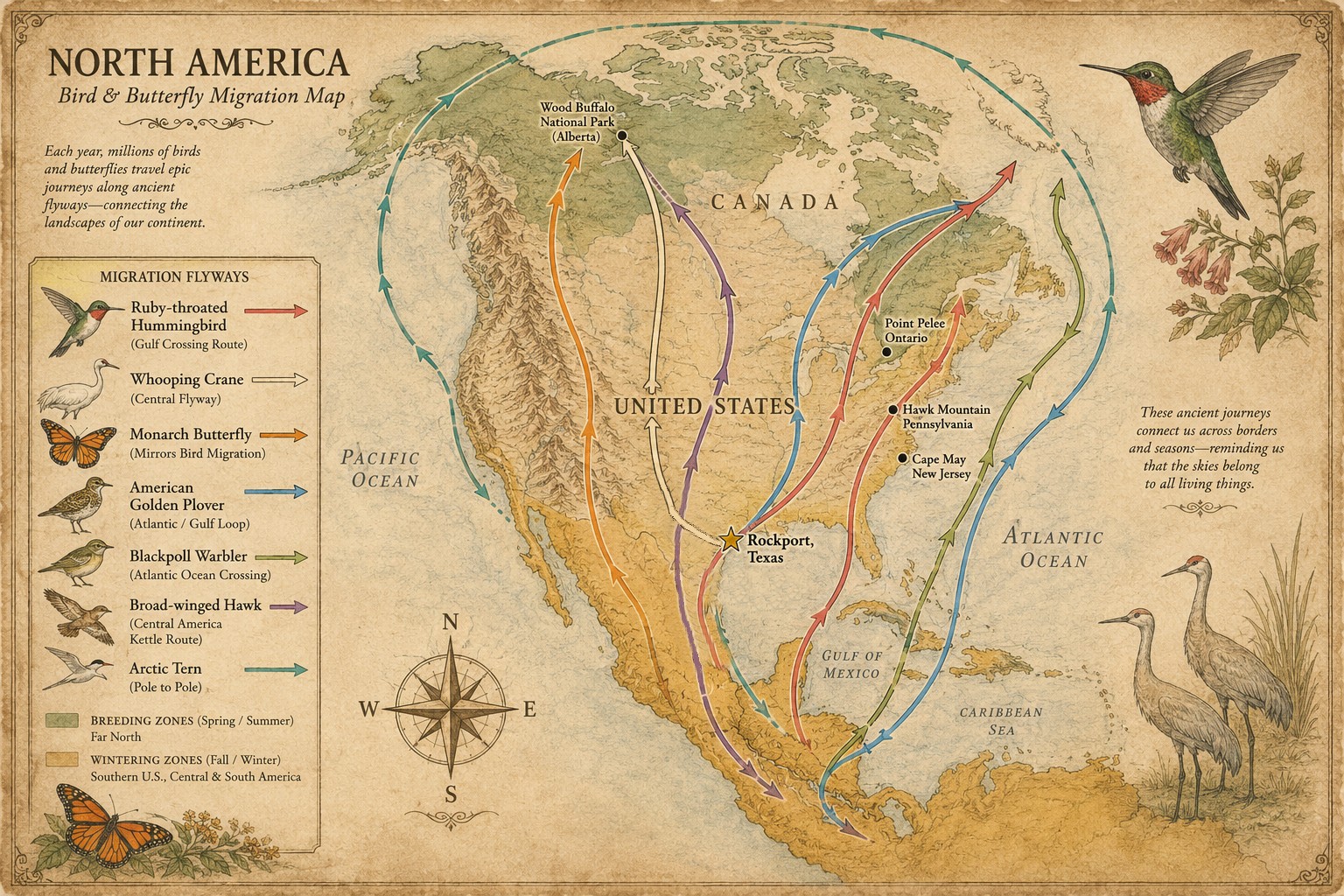
Texas sits at the intersection of four major North American flyways. Every spring and fall, billions of birds funnel through the state — making Texas the most important migratory crossroads on the continent.
Free Download
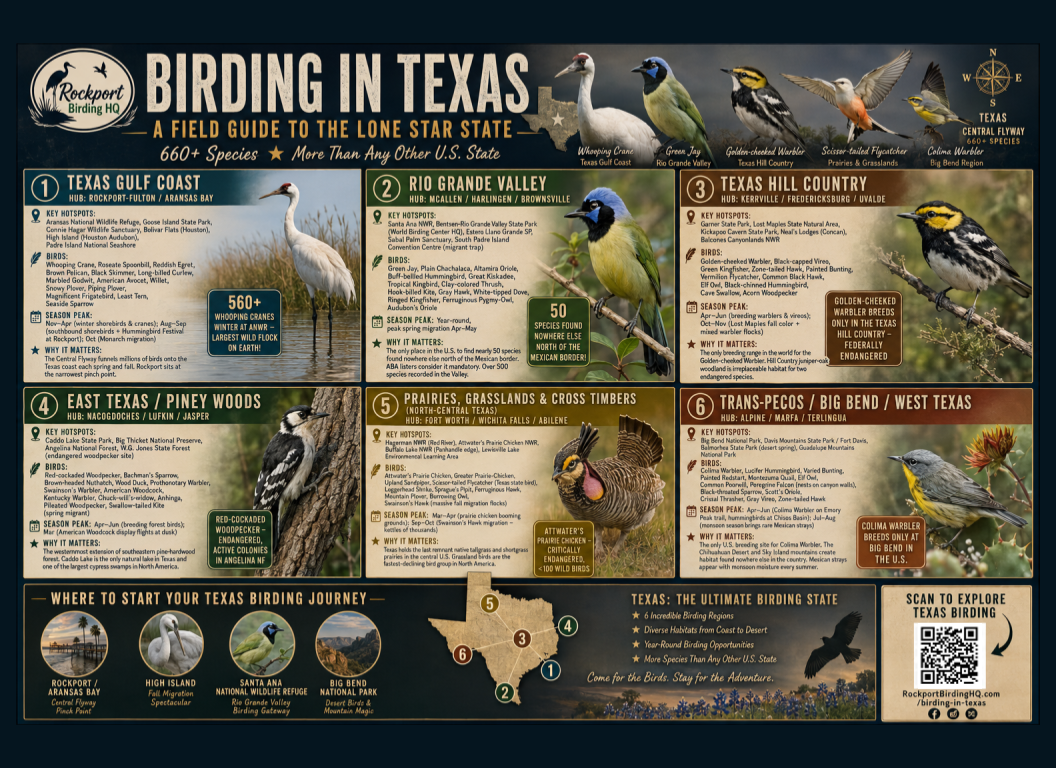
Texas Birding Hotspots Field Guide
All 6 regions on one printable guide — key hotspots, signature species, and best seasons for birding across the Lone Star State.
Download PDF Field GuideExplore by Region
Region 1
Texas Gulf Coast
Where the Central Flyway Meets the Sea
Key Hotspots
- →Aransas National Wildlife Refuge
- →Goose Island State Park
- →Rockport / Fulton
- →High Island (Houston Audubon)
- →Bolivar Flats
- →Padre Island National Seashore
Species to Find
- ✓Whooping Crane (560+ at Aransas — largest wild flock on Earth)
- ✓Roseate Spoonbill
- ✓Reddish Egret
- ✓Brown Pelican
- ✓Black Skimmer
- ✓Marbled Godwit
- ✓Long-billed Curlew
- ✓Piping Plover
- ✓Magnificent Frigatebird
Peak Season
Nov–Apr (cranes & shorebirds) · Aug–Sep (Hummingbird Festival) · Oct (Monarchs)
Why It Matters
The Central Flyway funnels millions of migrants onto the Texas coast. Rockport sits at the narrowest pinch point — making it the single most reliable birding address on the Gulf.
Region 2
Rio Grande Valley
50 Species Found Nowhere Else in the U.S.
Key Hotspots
- →Santa Ana NWR
- →Bentsen-Rio Grande Valley SP (World Birding Center HQ)
- →Estero Llano Grande SP
- →Sabal Palm Sanctuary
- →South Padre Island
Species to Find
- ✓Green Jay
- ✓Plain Chachalaca
- ✓Altamira Oriole
- ✓Great Kiskadee
- ✓Hook-billed Kite
- ✓Ringed Kingfisher
- ✓Ferruginous Pygmy-Owl
- ✓Clay-colored Thrush
- ✓Buff-bellied Hummingbird
Peak Season
Year-round · Peak spring migration April–May
Why It Matters
The only place in the U.S. to reliably find nearly 50 species found nowhere else north of the Mexican border. ABA listers consider it mandatory. 500+ species recorded in the Valley.
Region 3
Texas Hill Country
The Only Place on Earth for Two Endangered Birds
Key Hotspots
- →Balcones Canyonlands NWR
- →Lost Maples State Natural Area
- →Garner State Park
- →Neal's Lodges (Concan)
- →Kickapoo Cavern State Park
- →Davis Mountains State Park
Species to Find
- ✓Golden-cheeked Warbler (breeds ONLY in Texas — federally endangered)
- ✓Black-capped Vireo (federally threatened)
- ✓Painted Bunting
- ✓Vermilion Flycatcher
- ✓Green Kingfisher
- ✓Zone-tailed Hawk
- ✓Black-chinned Hummingbird
- ✓Elf Owl
Peak Season
Apr–Jun (breeding warblers) · Oct–Nov (fall color + migrant flocks)
Why It Matters
The only breeding range in the world for the Golden-cheeked Warbler. Hill Country juniper-oak woodland is irreplaceable habitat — loss of this ecosystem means extinction for two federally listed species.
Region 4
East Texas / Piney Woods
Ancient Forests, Cypress Swamps, Rare Woodpeckers
Key Hotspots
- →Caddo Lake State Park
- →Big Thicket National Preserve
- →Angelina National Forest
- →W.G. Jones State Forest
Species to Find
- ✓Red-cockaded Woodpecker (endangered, active colonies in Angelina NF)
- ✓Prothonotary Warbler
- ✓Swainson's Warbler
- ✓Wood Duck
- ✓Pileated Woodpecker
- ✓American Woodcock
- ✓Swallow-tailed Kite (spring migrant)
- ✓Bachman's Sparrow
Peak Season
Apr–Jun (breeding forest birds) · Mar (Woodcock display flights at dusk)
Why It Matters
The westernmost extension of southeastern pine-hardwood forest. Caddo Lake is the only natural lake in Texas and one of the largest cypress swamps in North America.
Region 5
Prairies & Grasslands
The Last Native Grasslands — and the Birds That Need Them
Key Hotspots
- →Hagerman NWR (Red River)
- →Attwater's Prairie Chicken NWR
- →Buffalo Lake NWR
- →Lewisville Lake Environmental Learning Area
Species to Find
- ✓Attwater's Prairie Chicken (critically endangered — fewer than 100 wild birds)
- ✓Upland Sandpiper
- ✓Scissor-tailed Flycatcher (Texas state bird)
- ✓Ferruginous Hawk
- ✓Mountain Plover
- ✓Burrowing Owl
- ✓Swainson's Hawk (kettles of thousands in fall migration)
Peak Season
Mar–Apr (prairie chicken booming grounds) · Sep–Oct (Swainson's Hawk migration)
Why It Matters
Grassland birds are the fastest-declining bird group in North America. Texas holds the last remnant native tallgrass and shortgrass prairies — and the last wild Attwater's Prairie Chickens on Earth.
Region 6
Trans-Pecos / Big Bend
Desert Sky Islands and Birds Found Nowhere Else in America
Key Hotspots
- →Big Bend National Park
- →Davis Mountains State Park
- →Balmorhea State Park
- →Guadalupe Mountains National Park
- →Fort Davis
Species to Find
- ✓Colima Warbler (breeds ONLY at Big Bend in the U.S.)
- ✓Lucifer Hummingbird
- ✓Varied Bunting
- ✓Painted Redstart
- ✓Montezuma Quail
- ✓Peregrine Falcon (nests on canyon walls)
- ✓Scott's Oriole
- ✓Gray Vireo
- ✓Crissal Thrasher
Peak Season
Apr–Jun (Colima Warbler on Emory Peak trail) · Jul–Aug (monsoon brings Mexican strays)
Why It Matters
The only U.S. breeding site for Colima Warbler. The Chihuahuan Desert and Sky Island mountains create habitat found nowhere else in the country. Mexican strays appear every monsoon season.
Texas Birding Regions & Hotspots
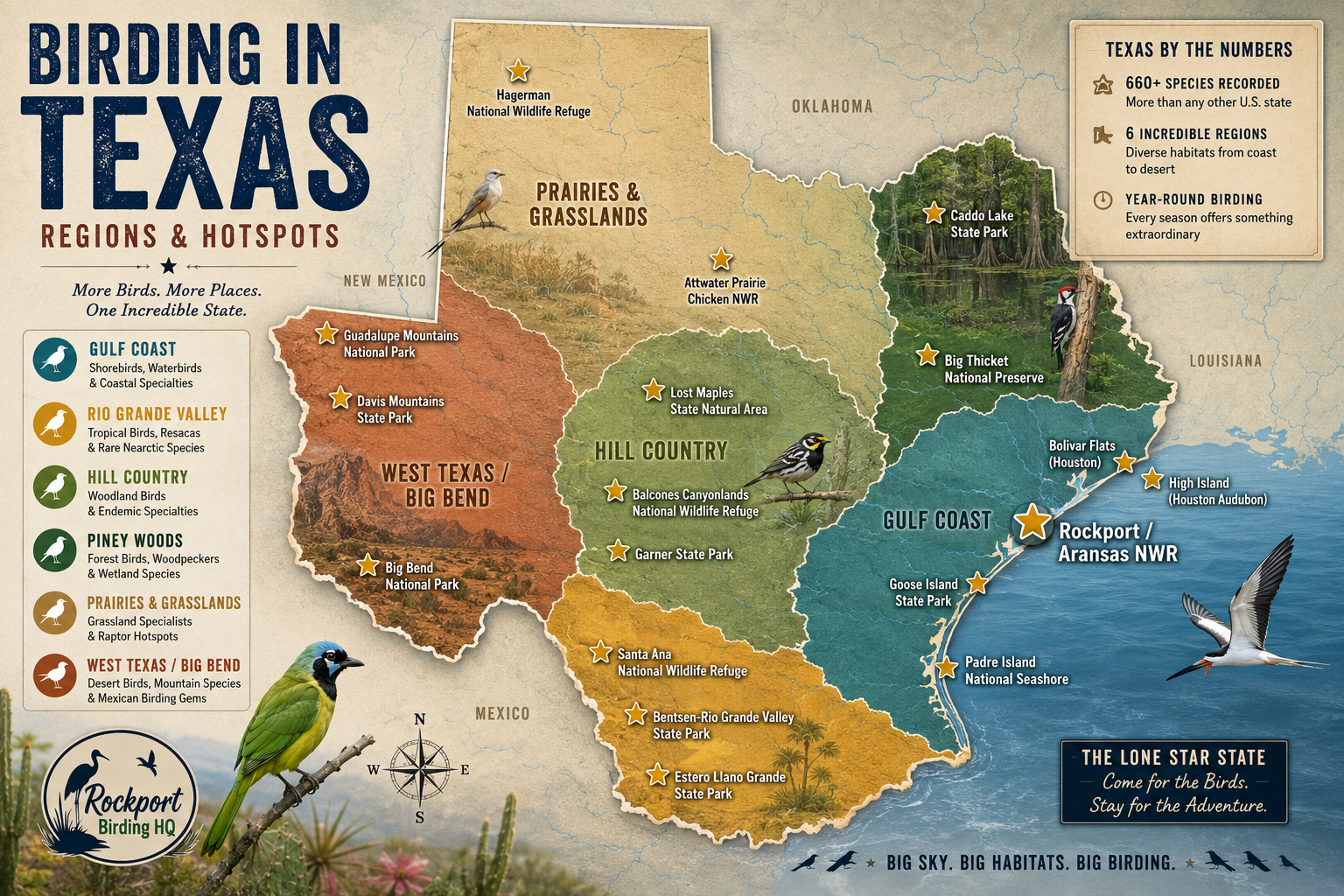
Start on the Gulf Coast
Rockport, Texas is the best single-destination starting point for a Texas birding trip — Whooping Cranes, Roseate Spoonbills, and shorebirds year-round, with easy day trips to the Rio Grande Valley and Hill Country.