
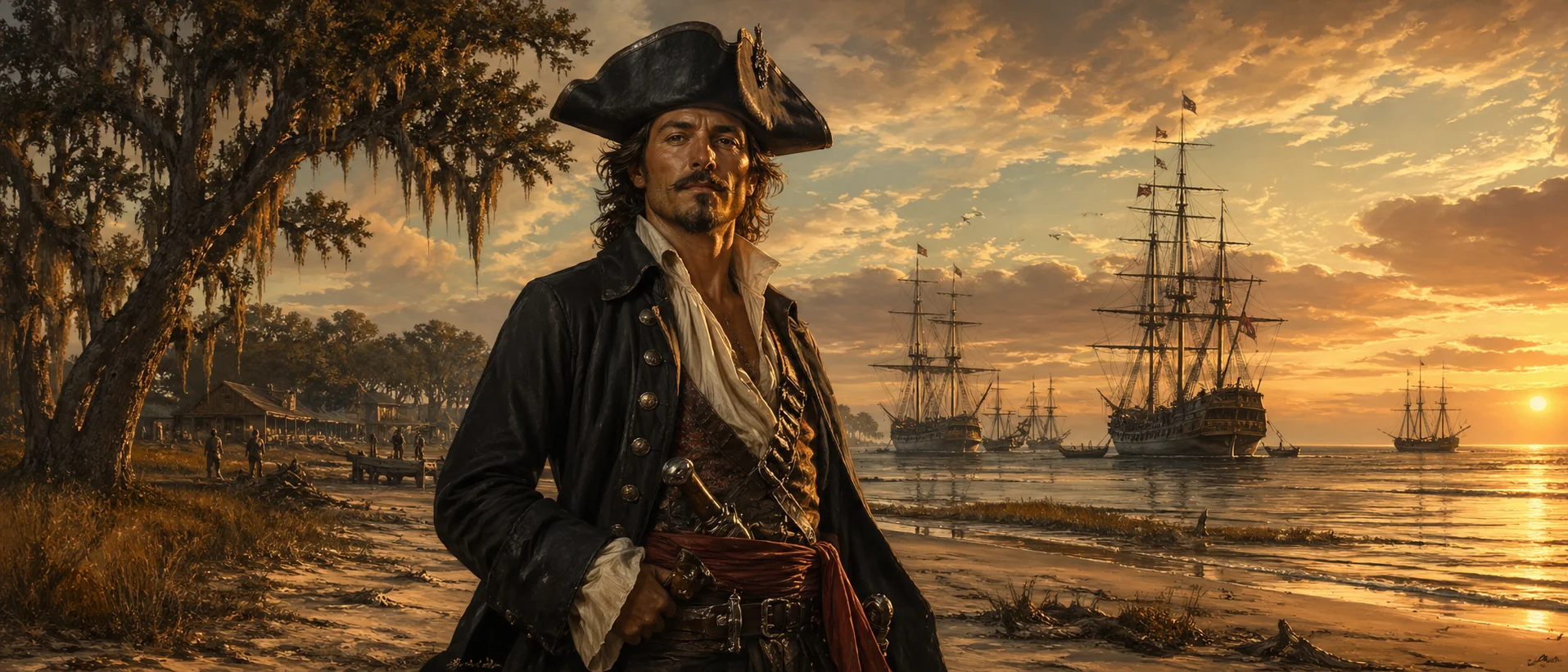
Texas Gulf Coast · 1817–1821
Jean Lafitte in Texas
Privateer. Smuggler. Hero of the Battle of New Orleans. And — if the legend is right — the man who buried his gold somewhere along this coast and never came back for it.
The Most Dangerous Man on the Gulf
Jean Lafitte was born around 1780 — probably in Bayonne, France, possibly in Haiti, depending on which account you believe. Even his name has two spellings. From the very beginning, the man was slippery. He arrived in New Orleans around 1804 with his brother Pierre, and within a few years the two of them had built the most profitable smuggling operation on the Gulf Coast. By 1812 Jean commanded a fleet of privateers from a fortified base on Grand Terre Island in Barataria Bay, Louisiana — a floating empire of stolen goods, enslaved people, and cannons pointed at anyone who came looking.
The United States government wanted him arrested. The governor of Louisiana put a price on his head. Lafitte responded by putting a larger price on the governor’s head. This is the kind of man we’re talking about.
Then the British invaded. In 1814, with the Royal Navy bearing down on New Orleans, General Andrew Jackson needed every gun he could find. Lafitte supplied them — cannons, powder, and 1,000 of his best fighters. The Americans won the Battle of New Orleans. Lafitte walked away with a full presidential pardon. The legend was just getting started.
Campeche — His Kingdom on Galveston Island
The U.S. government may have pardoned Lafitte, but they didn’t trust him — and they made his Louisiana operations impossible. In March 1817, Lafitte sailed west and claimed Galveston Island. Within a year he had built a fortified colony called Campeche, named after a Mexican port further south. At its peak the settlement held over 1,000 people: pirates, privateers, smugglers, merchants, and the enslaved people they trafficked through the Gulf.
At the center of it all was Maison Rouge — the Red House. A two-story fortified mansion with cannons mounted on the upper floor and a Jolly Roger flying from the roof. It served as Lafitte’s home, his headquarters, and his last line of defense. The Spanish flags he was supposed to fly under his letters of marque gathered dust. He answered to nobody.
A catastrophic hurricane in 1818 nearly destroyed everything — killing roughly half the colony’s residents. Lafitte rebuilt. He always rebuilt. But the U.S. government had seen enough. In 1821 the Navy sent the USS Enterprise to Galveston with a simple message: leave. On May 7, 1821, Lafitte departed. Before he left, his men burned Maison Rouge, the fortress, and the entire settlement to the ground. He was not the kind of man who left things for other people.
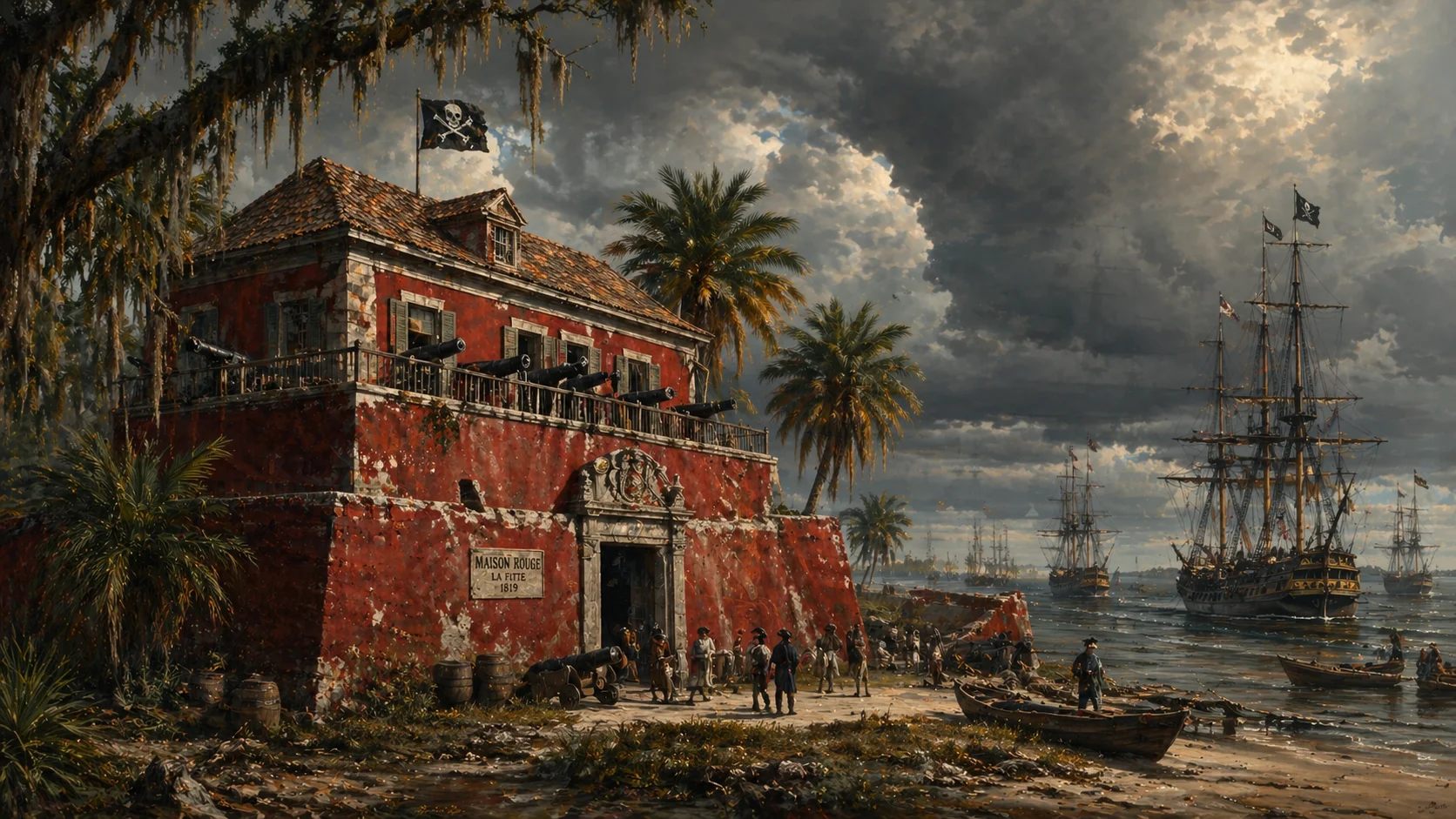
Maison Rouge — Lafitte’s fortified red headquarters at Campeche, Galveston Island. The Jolly Roger flew here from 1817 to 1821.
The Lamar Connection — Fact, Legend & a Red X on the Map
Here’s where history gets interesting — and honest. Lafitte’s documented base was Galveston, roughly 150 miles up the coast from Aransas Bay. No primary historical record places him operating specifically out of Lamar. But local legend on the Lamar Peninsula has always said otherwise, and there are threads worth pulling.
Consider: Mustang Island, just 20 miles south of Lamar at the mouth of Aransas Pass, is one of the most widely cited locations for Lafitte’s buried treasure in all of Texas history. Pirates didn’t stay in one place — they moved. Aransas Bay, with its shallow waters, barrier island access, and remote peninsula, was exactly the kind of geography Lafitte exploited.
Then there’s this: the town of Lamar was founded in 1839 and named for Mirabeau B. Lamar — president of the Republic of Texas. In 1843, Lamar personally investigated the stories surrounding Jean Lafitte and concluded there were no authentic records of his death. A head of state, two decades after Lafitte vanished, still chasing the story. That’s not nothing.
As for the girlfriend in Lamar, the buried gold, the rumored hideout on the peninsula — those stories live in the oral tradition of this coast and nowhere else. Which is either proof they’re folklore, or proof they were very well hidden. You decide.
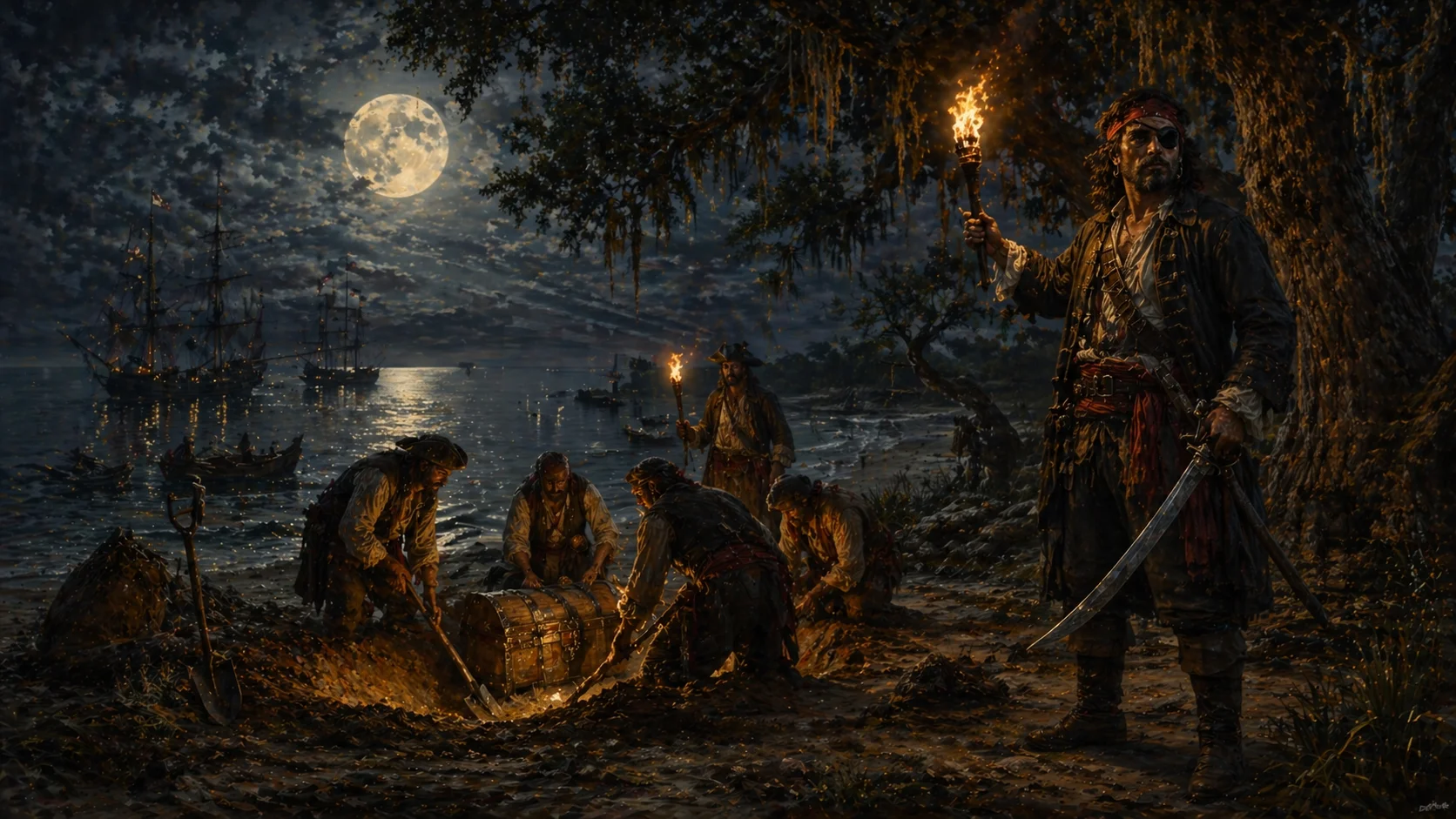
The live oaks along the Texas coast hide centuries of secrets. Nobody has ever proven the treasure doesn’t exist.
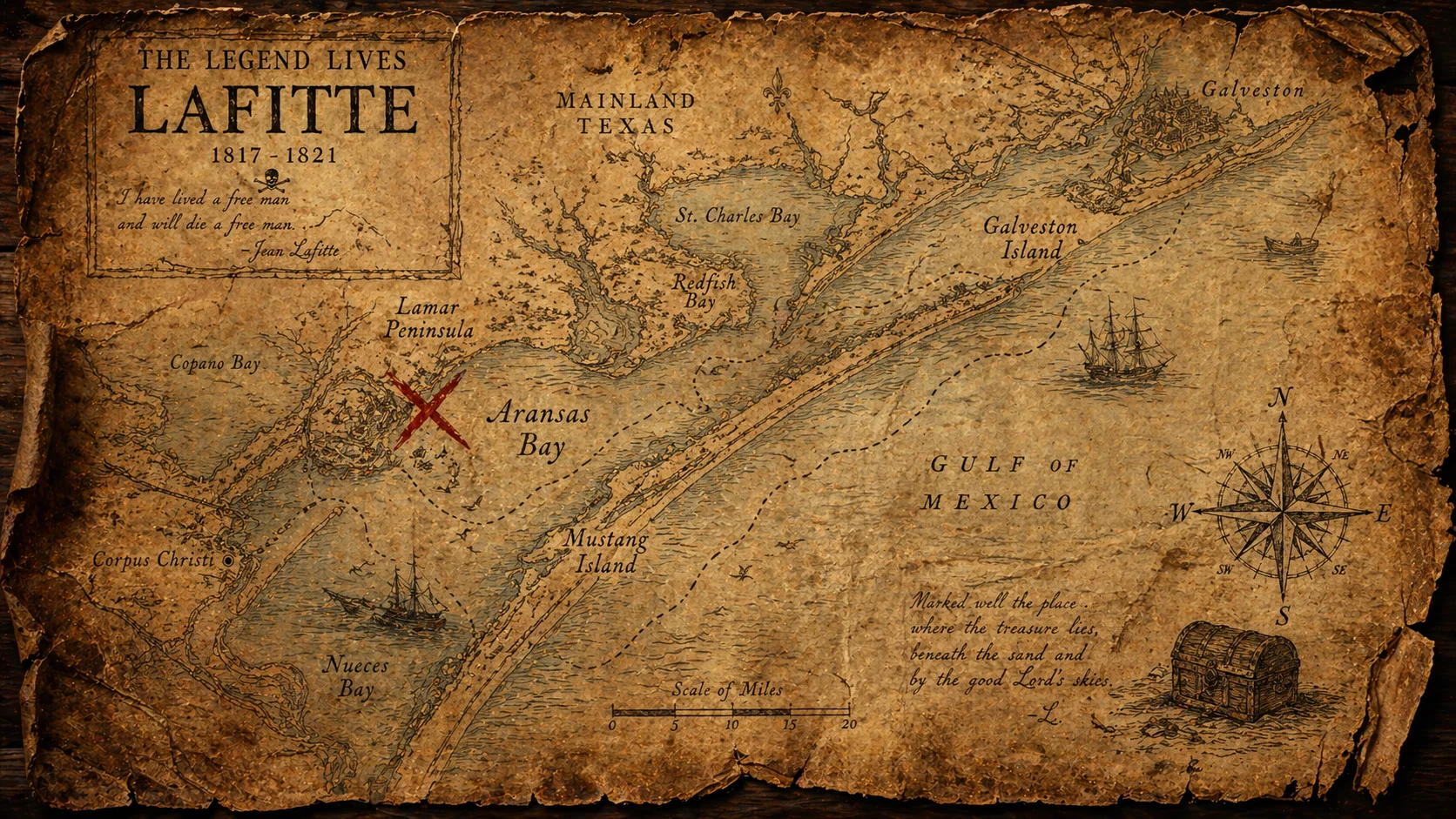
The red X marks Aransas Bay. Galveston Island to the north. Mustang Island to the south. Lamar Peninsula in between.
The Same Bay, 200 Years Later
The birds Lafitte’s crew would have seen sailing into Aransas Bay are the same birds here today. The Roseate Spoonbills feeding on the bay flats. The Brown Pelicans riding thermals over the barrier islands. The Whooping Cranes — even then, impossibly tall and white against the marsh grass. The coast hasn’t changed that much. The same shallow water, the same live oaks, the same egrets standing motionless at the shoreline.
When you walk the Wilderness Edge trail at Memorial Park, or scan the bay from Lamar Beach Road, or watch spoonbills wheel in the evening light over Aransas — you’re looking at the same geography Lafitte sailed through. That’s not a small thing. Two hundred years is nothing on the Texas coast.
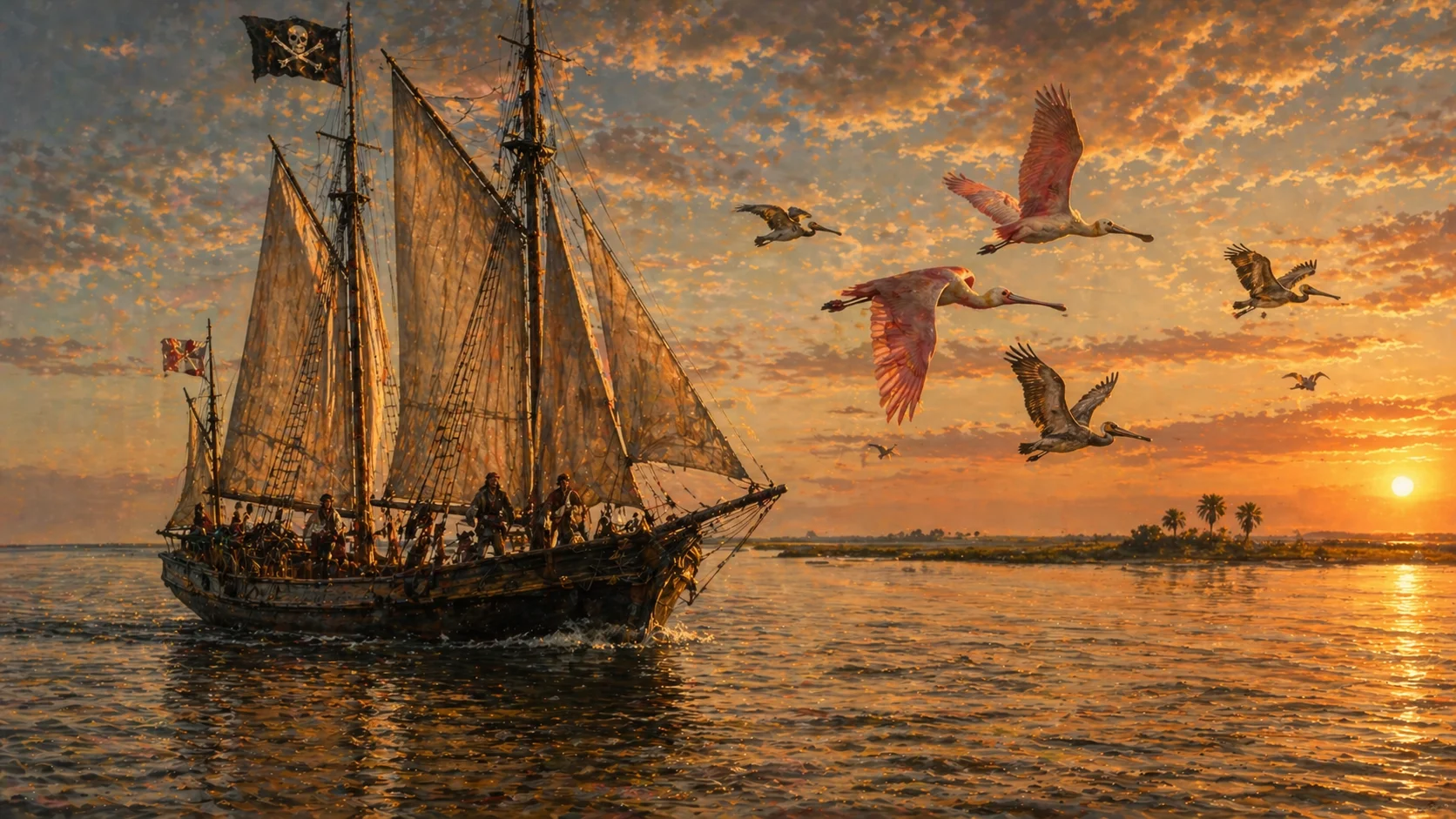
Roseate Spoonbills over Aransas Bay — the same birds Lafitte’s crew would have watched from the rigging, 200 years ago
What Happened to Lafitte
After burning Campeche and sailing away from Texas, Lafitte attempted to restart his operations near the Yucatán Peninsula and later Cuba. His luck had run out. On February 4, 1823, according to most accounts, he was mortally wounded commanding his schooner off the coast of Honduras and died the following morning at sea. He was approximately 42 years old. His body was almost certainly buried at sea. No grave has ever been found.
Except — and this is very Lafitte — conflicting accounts suggest he may have died of fever years later on Isla Mujeres off the Yucatán, that it was actually his brother Pierre who died in 1821, or that he faked his death entirely and lived out his years under a different name somewhere in the American South. Even in death, the man defied documentation.
As for the treasure: hundreds of expeditions have searched the Texas coast, the Louisiana bayous, and the Caribbean. Nothing of substance has ever been found. Which means either Lafitte never buried anything — or he buried it somewhere that nobody has thought to look yet. Somewhere like a quiet peninsula on Aransas Bay, where the spoonbills feed and the live oaks hold their secrets, and nobody has dug in the right spot.
More History & Nature of the Texas Coast