Raptors · Aransas Bay
Osprey
Pandion haliaetus · The Fishing Hawk
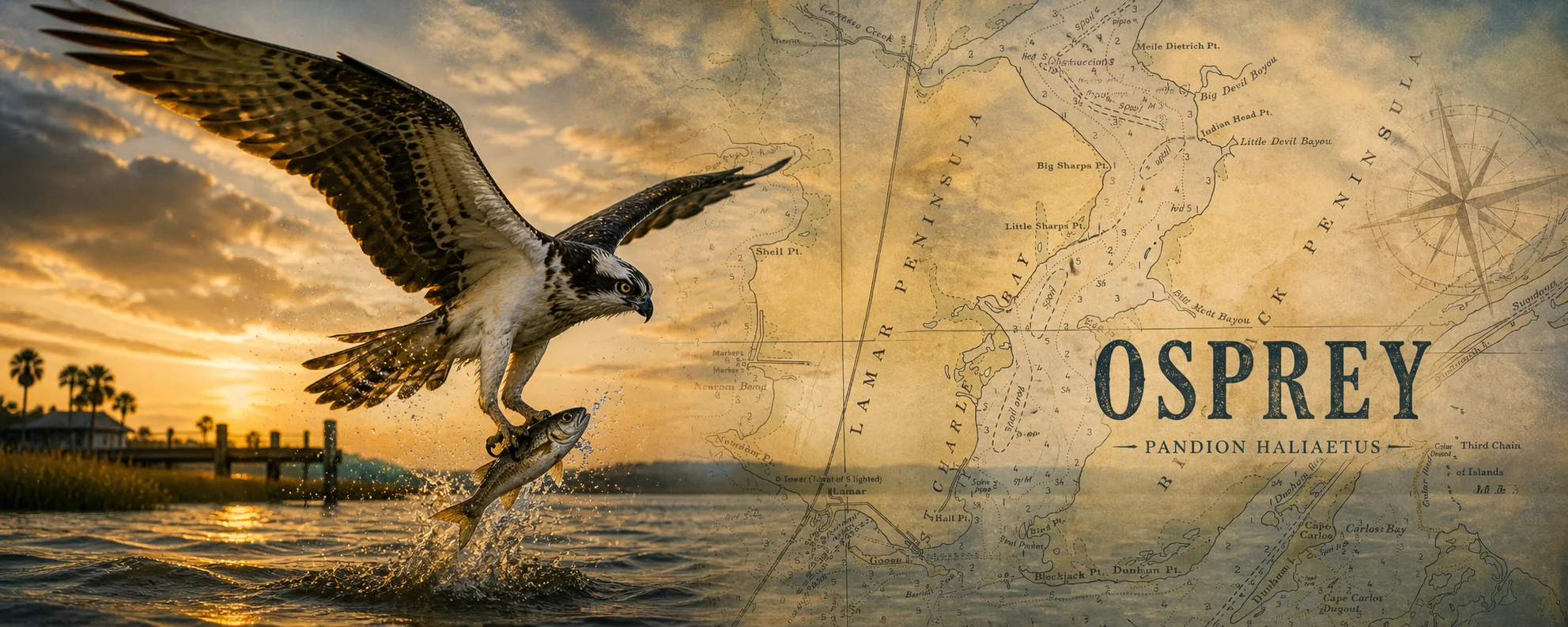
It circles high over the bay, spots a fish from 100 feet up, folds its wings, and drops. It hits the water at 40 miles per hour — feet first — and comes out with a live fish in its talons. Then it shakes off the water mid-air and flies away. Nothing else on the Texas coast hunts quite like the Osprey.
Quick Facts
The Most Specialized Hunter on the Bay
The Osprey is the only raptor in North America that dives completely into the water to catch prey — and it has evolved a remarkable suite of adaptations to do it.
Its outer toe is reversible — it can face forward or backward, giving the Osprey a two-and-two grip on a slippery fish that no other hawk can match. The toe pads are covered in sharp, curved spicules that act like velcro on wet scales.
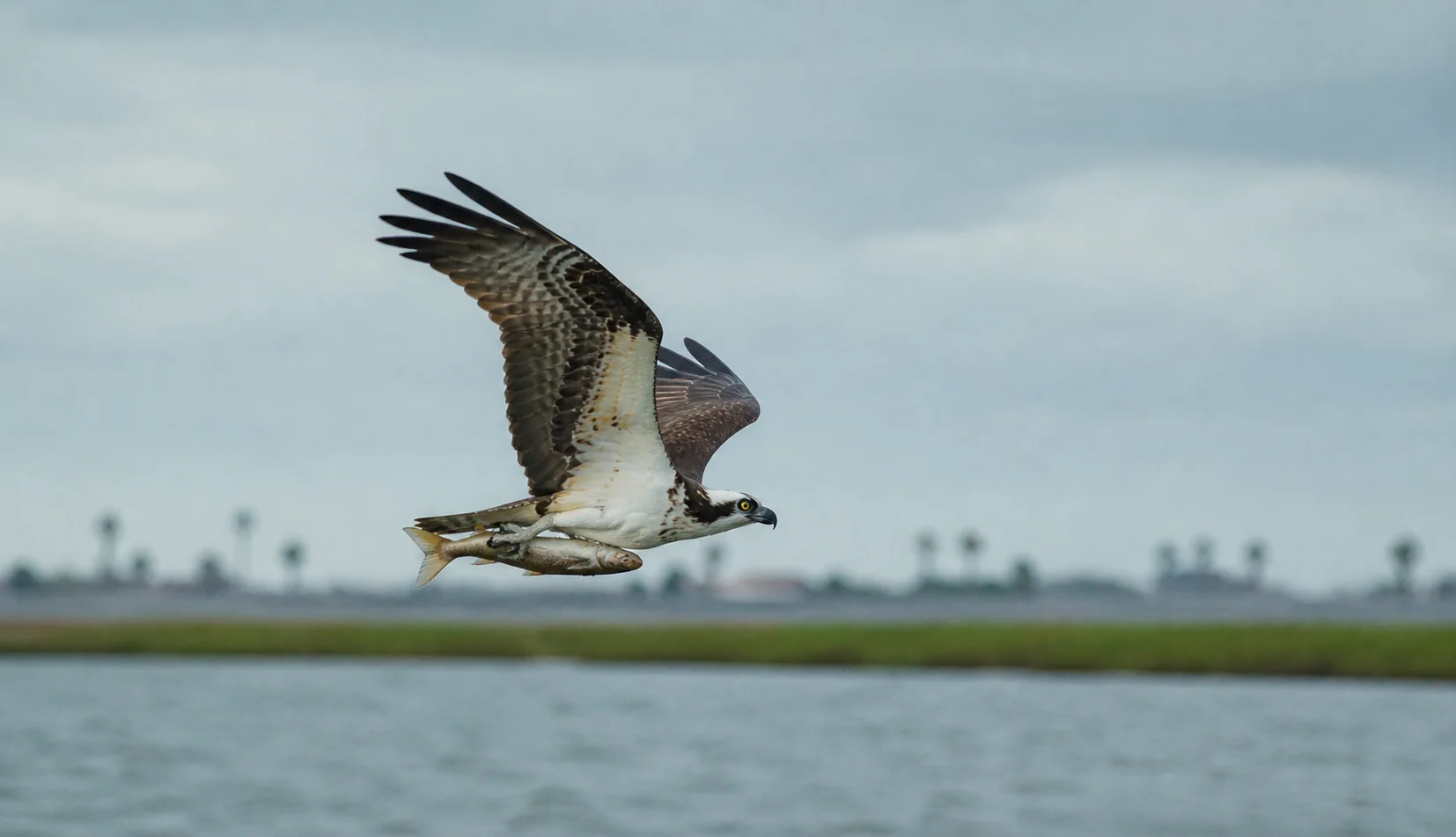
The nostrils close automatically on impact. The plumage is dense and oily to shed water. After a successful dive the bird rises from the surface, shakes like a dog mid-air, then rotates the fish headfirst into the wind — aerodynamics, even in victory.
Watch one long enough over Aransas Bay and you'll see the full sequence: the hover, the fold, the plunge, the eruption from the water, the shake, the flight. On a good day it takes less than thirty seconds.
How to Identify an Osprey
In Flight
- →Large — nearly 6-foot wingspan, similar to a Bald Eagle
- →Bold white underparts with brown "wrist patches" — the key field mark
- →White head with a distinctive brown eye stripe through the face
- →Wings bent at the wrist in a shallow M-shape — unlike any other raptor
- →Slow, deep wingbeats; hovers before diving
Perched
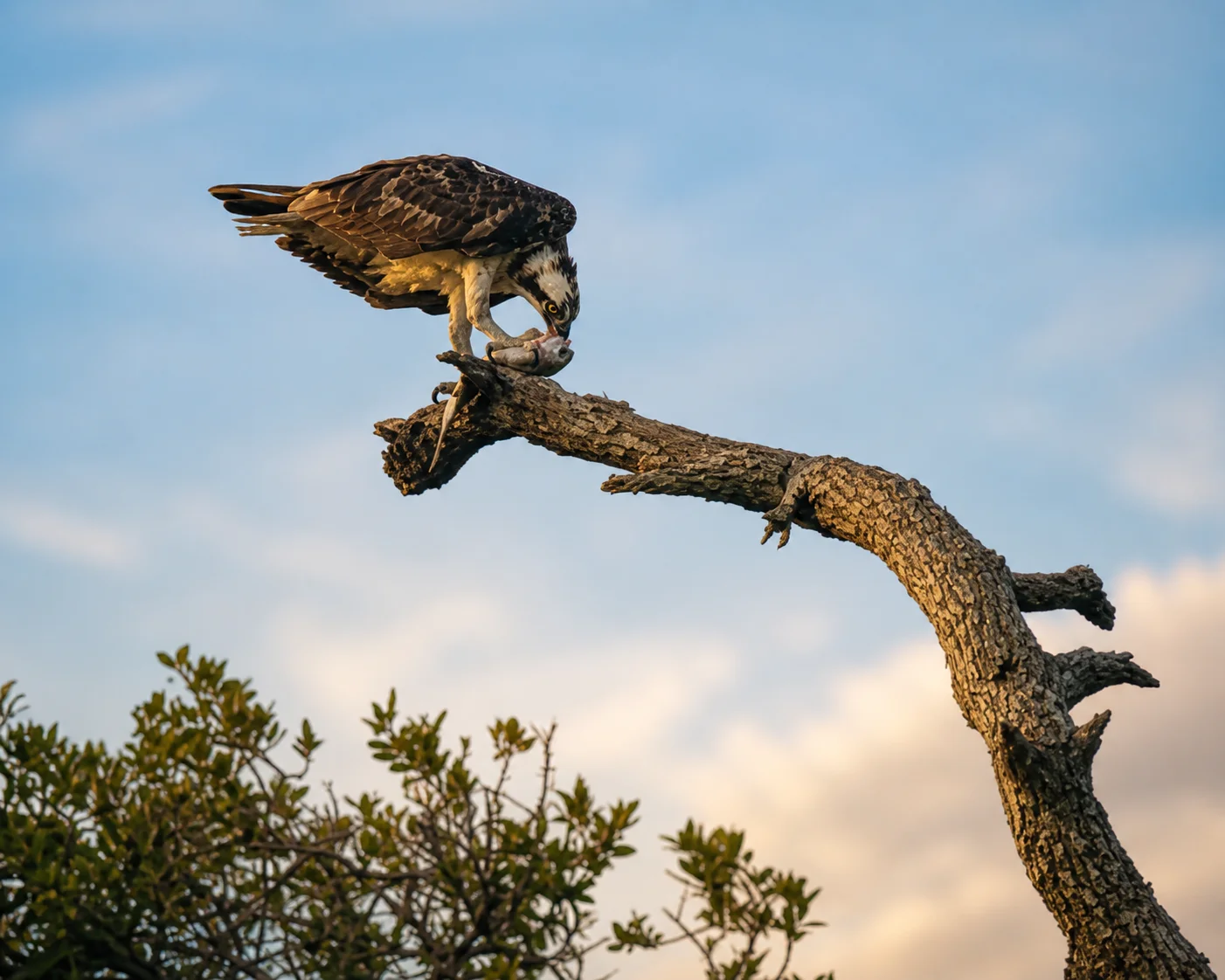
- →Brown above, white below — clean, high-contrast look
- →Yellow eyes, hooked bill
- →Often perches on dead snags, channel markers, and dock pilings
- →Frequently seen eating a fish on a favorite perch
- →Nests on tall structures — channel markers, cell towers, osprey platforms
Don't confuse with Bald Eagle
Both are large and fish-eating, but the Osprey is brown-and-white throughout with that bent-wing M-shape. Bald Eagles are all dark with a white head and tail only (adults). Eagles will actually steal fish from Ospreys — watch for aerial chases over Aransas Bay.
Osprey at Rockport — Year-Round on Aransas Bay
Rockport and the Lamar Peninsula sit along one of the richest stretches of inshore fishing habitat on the Texas coast — and Ospreys know it. Aransas Bay's shallow flats, protected coves, and abundant redfish, flounder, and mullet make it prime Osprey territory year-round.
Some Ospreys are year-round residents that nest nearby; others are winter visitors that breed farther north and spend the cooler months fishing the Texas coast. During fall migration, numbers spike noticeably as birds moving south pass through.
The Goose Island State Park fishing pier is one of the most reliable Osprey-watching spots in the area — birds regularly perch on the pier structure and channel markers nearby. Little Bay along the Rockport waterfront is another consistent spot, especially on calm mornings when fish are visible near the surface.
On any Aransas Bay boat tour, you're almost guaranteed an Osprey sighting — local captains regularly spot them hunting over the shallow flats near the whooping crane habitat.
Conservation
From the Brink — One of Conservation's Great Comeback Stories
By the 1960s, Osprey populations across the eastern United States had collapsed — DDT, the widespread pesticide, was accumulating in fish and thinning the eggshells of fish-eating birds. Osprey eggs crushed under incubating parents. Populations along the Atlantic coast fell by 90% in some areas.
DDT was banned in the US in 1972. The Osprey's recovery was almost immediate — within a decade, populations were rebounding. Today the species is thriving across North America and has even expanded its range. The Osprey is one of the great success stories of the environmental movement, proof that when the cause of decline is removed, nature recovers.
When to See Osprey at Rockport
Spring
Mar – May
Migrants heading north; resident birds nest
Summer
Jun – Aug
Resident birds; juveniles learning to fish
Fall
Sep – Nov
Peak migration — highest numbers of the year
Winter
Dec – Feb
Winter residents; excellent fishing conditions
Osprey are present at Rockport every month of the year — fall migration brings the largest concentrations.