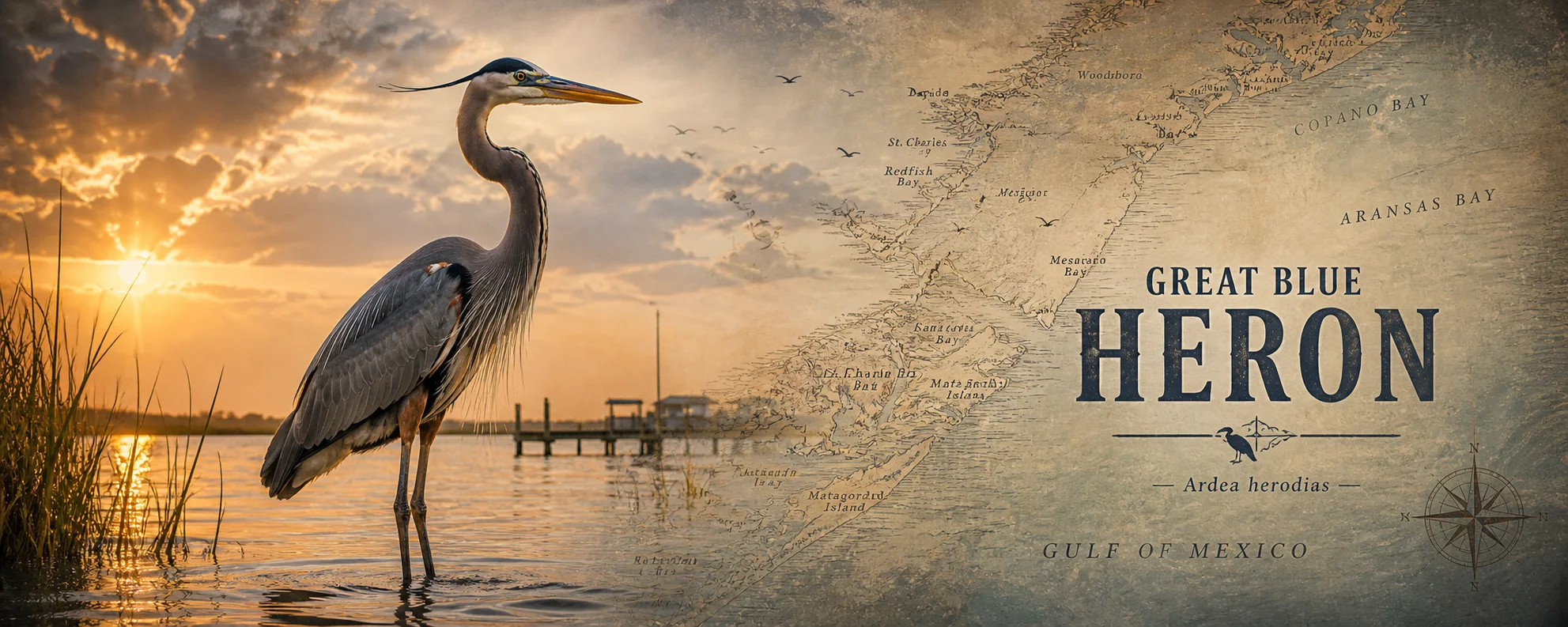
Wading Birds · Aransas Bay
Great Blue Heron
Ardea herodias · The Patient Hunter
It stands at the water's edge without moving — not for seconds, but for minutes. Then, in less than a tenth of a second, it strikes. The Great Blue Heron is the tallest heron in North America and one of the most skilled ambush predators on the Texas coast. You've seen one on every dock in Rockport. You may not have realized what you were looking at.
Quick Facts
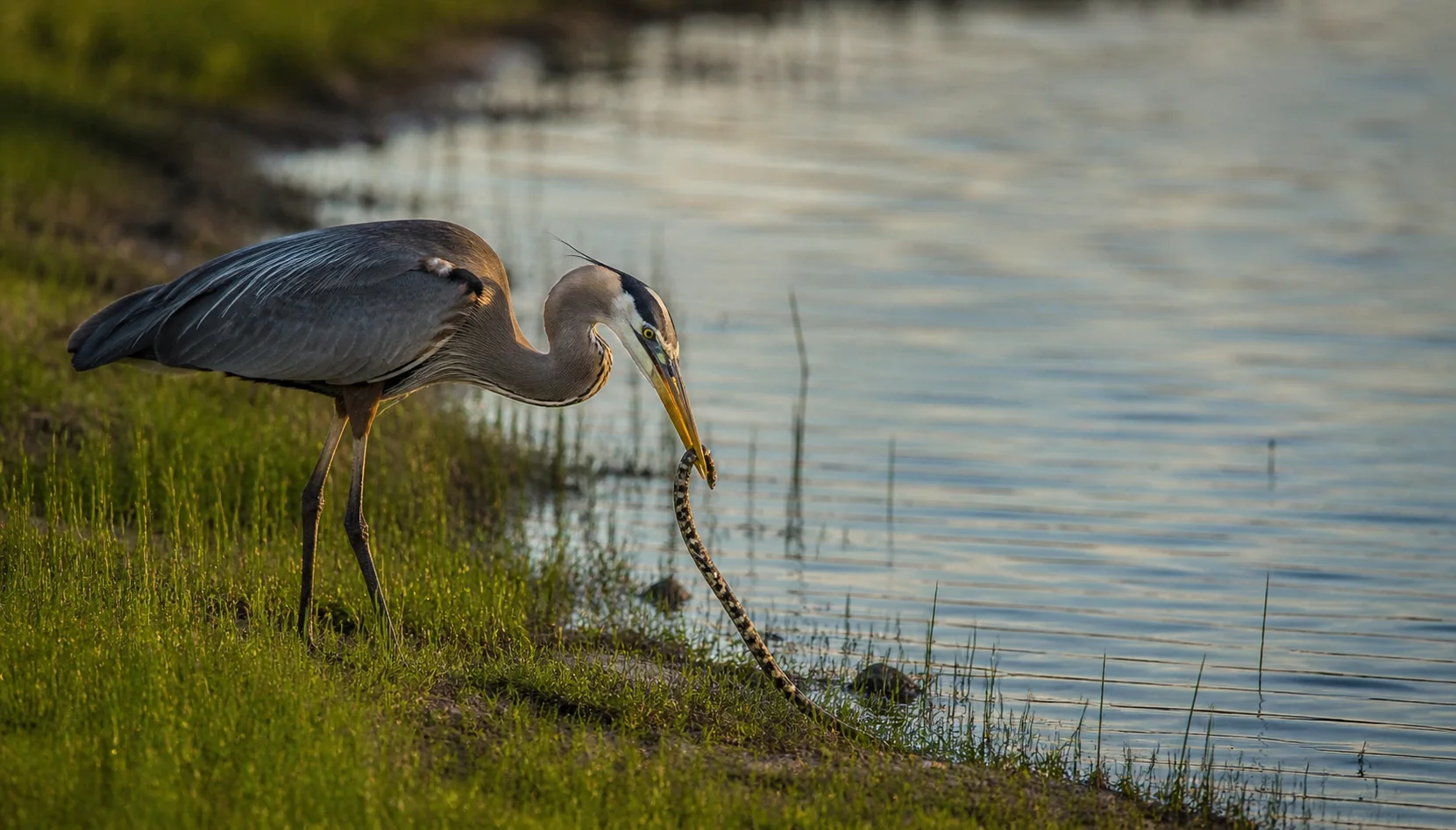
GBH with a water snake — Aransas Bay. They eat far more than just fish.
How It Hunts
The Art of Stillness — Then an Explosion
The Great Blue Heron hunts by ambush. It wades slowly into position — or just stands and waits — holding absolutely still until prey enters its strike zone. That patience is the strategy. Fish ignore a statue. They don't ignore movement.
When the moment comes, the neck uncoils like a compressed spring. The bill hits water in less than 100 milliseconds — faster than a human eye can track. Most strikes end with a fish. Some end with a snake, a frog, or a lizard. The GBH is not particular about what swims within reach.
< 0.1s
Strike time
7 ft
Wingspan
4.5 ft
Standing height
They Eat More Than You Think
Most people assume the Great Blue Heron eats only fish. It does — mostly. But it's an opportunistic hunter that will take nearly anything it can swallow whole.
Fish
The primary prey — flounder, mullet, redfish, sheepshead. Can swallow fish up to 12 inches long.
Snakes
Water snakes and small cottonmouths are fair game. The spear-like bill pins them before they can strike back.
Frogs & lizards
Shallow marsh edges are prime foraging ground — anything that sits too still in the shallows.
Small mammals
Mice, voles, and even small rats near water edges. The GBH hunts fields at dusk as well as shorelines.
Crabs & shrimp
Common in the estuaries and tidal flats around Aransas Bay — especially at low tide.
Baby birds
Rare, but documented. Ducklings and small shorebird chicks are vulnerable to a hunting GBH.
How to Identify a Great Blue Heron
Standing / Wading
- →Massive — 4.5 feet tall, taller than a great egret
- →Blue-grey overall with a white face and black eye stripe
- →Long rust-orange and black streaking on the neck
- →Thick yellow-orange bill — heavy, dagger-shaped
- →Shaggy plumes on chest and back in breeding season
- →Stands hunched or fully upright — posture changes with mood
In Flight
- →Enormous wingspan — nearly 7 feet, prehistoric silhouette
- →Neck folded back in a tight S-curve — key field mark
- →Slow, deep wingbeats — almost lazy-looking for its size
- →Legs trail straight behind, feet barely visible
- →Often utters a harsh "frahnk" call when flushed
- →Can look dark or even black at distance
Don't confuse with Great Egret
The Great Egret is all-white with a yellow bill and black legs. The Great Blue Heron is grey-blue with an orange-yellow bill and dark legs. Both are large wading birds common in Rockport — watch for color.
Don't confuse with Sandhill Crane
In flight both look enormous and grey. Cranes fly with their neck extended straight out — herons fold theirs into an S. Sandhill Cranes also have a distinctive red forehead and are far less common on the coast.
A Permanent Fixture on the Rockport Waterfront
Most birds require effort — the right season, the right trail, the right morning. The Great Blue Heron requires nothing. It is simply there. On the dock piling at Fulton Harbor. On the seawall at Little Bay. Perched above the shrimp boats at the waterfront. The same birds return to the same spots day after day — some individuals hold territory for years.
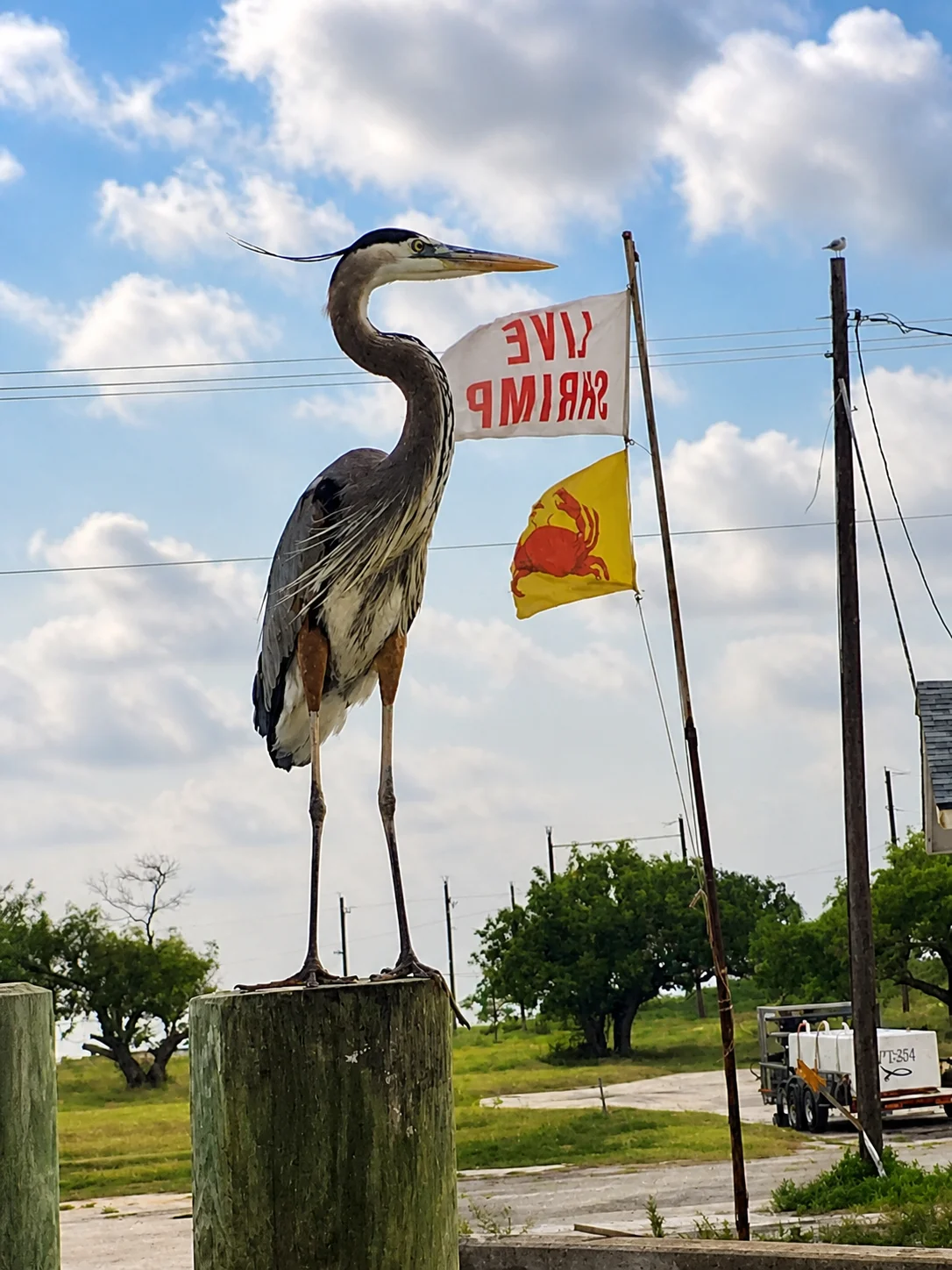
GBH at the Rockport waterfront — "Shrimp Live" dock. Photo: Rockport Birding HQ.
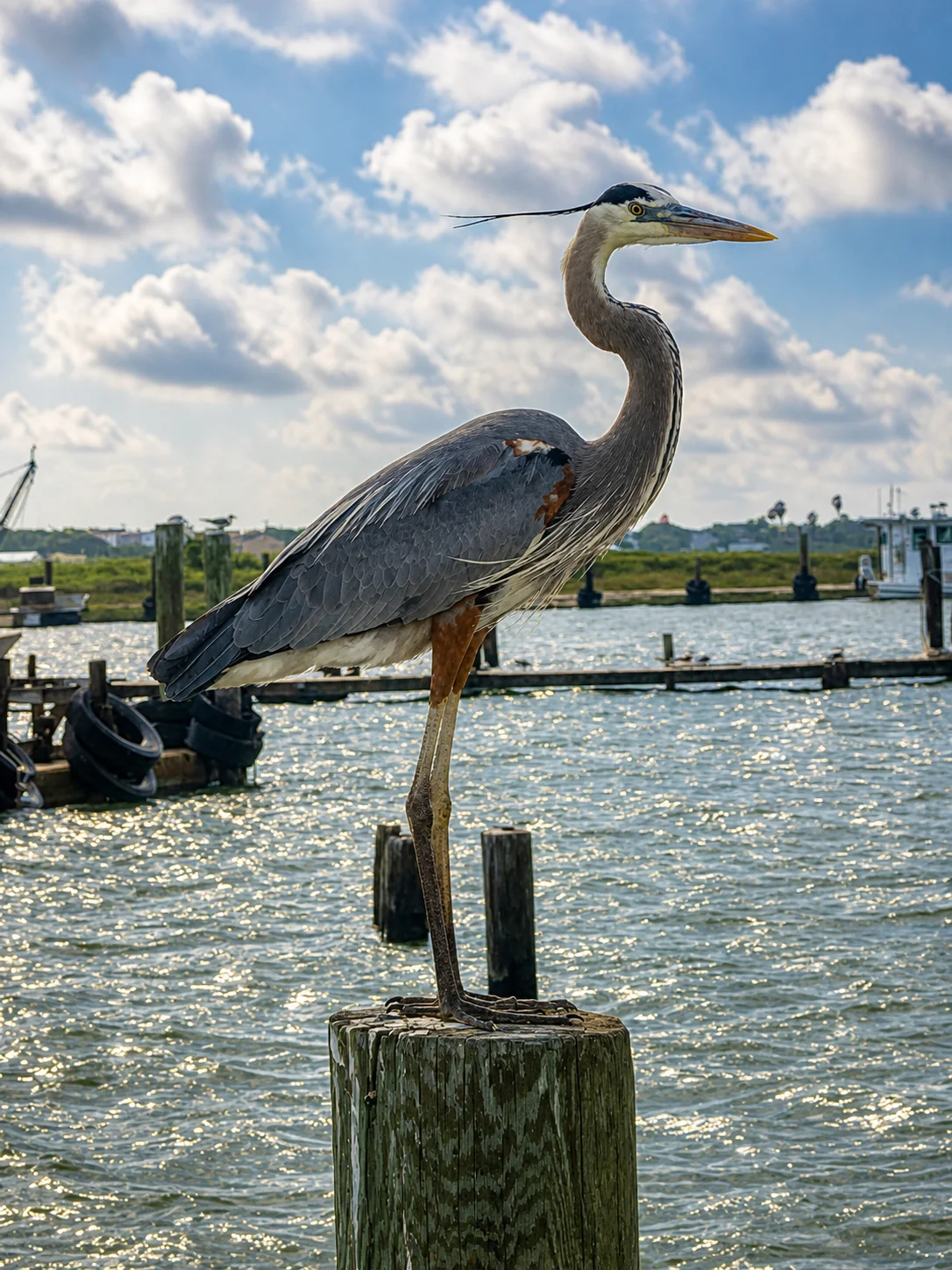
Aransas Bay dock — a GBH holds its usual perch at dawn. Photo: Rockport Birding HQ.
Colonial Nesters — The Heronry
Great Blue Herons don't nest alone. They form heronries (also called rookeries) — colonies of dozens to hundreds of nesting pairs in large trees, often near water. The nests are massive stick platforms, reused and added to year after year until they reach several feet across.
In the Aransas Bay area, heronries are often established in live oaks or tall dead snags near protected coves. The colony can be heard before it's seen — a constant croaking, clattering, and squabbling from the canopy.
Breeding season in Texas runs from January through June. Eggs hatch after 28 days of incubation; chicks fledge at about 60 days. Both parents feed the young by regurgitating partially digested fish directly into the nest.
Young herons take 2 years to reach adult plumage. Juveniles lack the black crown stripe and white face of adults — they're overall browner and can be mistaken for a different species at first glance.
When & Where to See Great Blue Herons at Rockport
Spring
Mar – May
Nesting activity; adults at heronry and feeding young
Summer
Jun – Aug
Juveniles dispersing; adults back to bay fishing
Fall
Sep – Nov
Highest numbers — winter visitors arriving from north
Winter
Dec – Feb
Large numbers; calm bay mornings are best for watching
Great Blue Herons are present in Rockport every single day of the year — you cannot miss them.
Things Worth Knowing
The GBH is More Remarkable Than It Looks
They can choke
GBH occasionally attempt fish too large to swallow and die of asphyxiation. A 4.5-lb bird trying to eat a 2-lb catfish is not always a winning proposition.
They're mostly silent — until they're not
The GBH is quiet while hunting. Flush one from a hiding spot and you'll hear the alarm call — a prehistoric, raspy "frahnk" that carries across the water.
They have powder down
Specialized feathers on the breast produce a fine powder used to clean fish slime from the plumage. The comb-like middle claw spreads the powder like a brush.
They can live 15+ years
The oldest wild GBH on record lived 24 years. Rockport birds you've seen on a specific dock may have been holding that territory for a decade.