A Podcast by Rockport Birding HQ
Tales from the Texas Coast
There’s a version of Rockport you get from brochures. This is the other one.
Tales from the Texas Coast is a free audio series about the history, wildlife, and untold stories of the Texas Gulf Coast. The birds that came back from extinction. The plants the Karankawa lived on. The historical figures who shaped this coastline and the battles nobody teaches. The kind of local knowledge that only comes from actually living here.
Some episodes pair with self-guided driving tours of Rockport and the Lamar Peninsula. All of them give you the version of the coast the brochures miss. Press play in your browser, your car, or Spotify — no account needed.
Pick an episode
below
Open the driving tour
linked on each card
Play as you go
free, no signup
.webp)
“Started episode one. Currently on episode eight.
No memory of two through seven.”
NO REGRETS.
— Zip
18 Episodes — New episodes added as routes are released
Pirates, Presidents & the Lamar Peninsula
The Lamar Peninsula juts into Aransas Bay like a finger pointing at the Gulf. Drive it slowly. There's more history packed into these seven miles than most Texas counties can claim in a lifetime. The 1,000-year-old Big Tree stands at the corner of Twelfth Street in Lamar — a coastal live oak that was already ancient when Spanish explorers first mapped this bay. It survived hurricanes, droughts, and a century of coastal development. Ripley's Believe It or Not featured it, which is exactly the kind of fact this coast specializes in. Irish colonists established the settlement of Lamar in 1838 on a land grant awarded to empresario James Power — the same James Power who crossed the Atlantic, recruited settlers from County Wexford, and watched roughly 150 of them die of cholera in New Orleans before they ever reached Texas. The ones who made it settled this peninsula. El Copano, the colonial port on Copano Bay's northwest shore, was the entry point. Samuel Colt — of Colt revolver fame — held land grants in this area during the Republic of Texas era. The Confederate salt works that Union naval raiders burned to the ground in 1862 sat on this same shoreline. All of it is here, within a 45-minute drive. This episode pairs with the Lamar Peninsula Loop driving tour.
Drive this route
Lamar Peninsula Loop →Rockport Birding & Hogs Bayou Alligators
In 1935, a woman named Connie Hagar moved to Rockport, took over a small tourist motel on Little Bay, and started walking. She walked nine miles of Texas coastline every single day for the next 35 years. This is her route. The Rockport Birding Circuit passes the sanctuary she built at Little Bay, where roseate spoonbills, reddish egrets, tricolored herons, and snowy egrets nest in concentrations that are unusual even for the Texas coast. The colonial nesting colony here gathers because Connie Hagar spent years creating conditions for it and because the bay's shallow water and protected coves provide exactly what wading birds need. Reddish Egrets are the headliner — one of the rarest herons in North America, with roughly 2,000 breeding pairs on the entire continent, and a significant percentage of them nest here. Watch one hunt: it runs, staggers, opens its wings like a canopy, and spins in circles. It looks like it's lost its mind. It's one of the most effective hunting strategies in the bird world. Hogs Bayou sits at the south end of the circuit, where the Lamar Peninsula meets the estuary. The alligator corridor here is easy to miss if you're not looking for it. Look for logs that have eyes. This episode pairs with the Rockport Birding Circuit driving tour.
Drive this route
Rockport Birding Circuit →Whooping Cranes and Why Rockport Is the Best Birding Destination on the Texas Coast
In 1941, a wildlife biologist counted every whooping crane on Earth. He found 15. Today the Aransas-Wood Buffalo flock numbers 560-plus birds — the result of the most intensive crane recovery effort in American conservation history. Every one of them winters on Aransas Bay. Rockport is their address. But the whooping cranes are just November through March. The rest of the year, this bay runs a calendar most birders don't know exists. September brings the HummerBird Celebration — 38th annual in 2026, running September 17–20 — when tens of thousands of hummingbirds funnel down the Texas coast through Rockport. Feeders drain overnight. Nine species have been documented here. The concentration is one of the densest hummingbird migration events anywhere in North America. Spring migration brings fallout events — moments when exhausted songbirds crossing the Gulf of Mexico hit the Texas coast and drop into the nearest tree. Summer is shorebird season, when Aransas Bay hosts species that breed in the Arctic and won't return north for months. Lamar Beach Road — seven miles from downtown Rockport, free, no gate, no boat required — is the best accessible whooping crane viewing spot on the coast. You can watch them feed at road level without a guide and without paying anything. This episode covers when to come, where to go, and what local knowledge looks like when someone actually lives here.
Eleven Pirate Ships Buried in Texas Mud
Eleven pirate ships. Buried in the mud of Aransas Bay. Not legend — documented. This episode follows the privateers who used the Texas coast as their base of operations before Texas was Texas. The same bays where whooping cranes land every November were once staging grounds for ships carrying letters of marque, contraband, and the crew of Jean Lafitte. Some of those ships never left.
Drive this route
Lamar Peninsula Loop →Texas Coast Birding Festivals: Galveston FeatherFest, High Island Fallouts, and the Migration Calendar
A statewide guide to the Texas coast birding festival calendar — from the famous High Island fallouts at Galveston FeatherFest in April, where exhausted migrants drop from the sky after crossing the Gulf of Mexico, to the HummerBird Celebration in Rockport every September. This episode covers the full migration calendar: spring warbler waves, summer shorebird diversity, fall hummingbird concentrations, and winter crane season. For birders planning a Texas coast trip and wanting to know which festival to build it around.
The Civil War-Lamar Salt Works and Union Raid
Salt was as important to the Confederacy as ammunition. You couldn't preserve food without it. You couldn't cure gunpowder without it. And when the Union blockade cut off the Gulf ports, the salt works on the Lamar Peninsula became a strategic target. This episode follows the Confederate salt operation on Aransas Bay — who built it, what it took to run it, and the Union naval raid that came up from the Gulf and burned it to the ground. The same peninsula where whooping cranes feed every winter was, for a few years, a wartime industrial site.
Drive this route
Lamar Peninsula Loop →Sorenson-Stair Building & The High Price of Killing Texas Mosquitoes
In 1886, a Danish sailor named Simon Sorenson was put ashore in Rockport with malaria and left there. He never left. He built a mercantile that still stands at 406 S. Austin Street. This episode follows the fever that stranded him — and traces malaria from a ship dock on Aransas Bay to John Muir collapsing in a Florida swamp, to the federal program that killed it with DDT, to the brown pelicans and bald eagles that nearly disappeared from this coast as a result. The mosquito trucks still run at dawn. The whooping cranes are still in the same water.
Rockport-Fulton Festivals and Annual Events Guide
This episode is a practical guide to the recurring and annual events in Rockport-Fulton — the ones that give visitors a reason to come any month of the year. Monthly staples like art walks, the Second Saturday Farmers Market, and the Dog'Gone Songwriter Series keep the community running year-round. Seasonal festivals go deeper: Lamar DiGras and Fulton OysterFest are volunteer fire department fundraisers that have nothing to do with tourism and everything to do with the town. The HummerBird Celebration in September brings birders from across the country. The Wendell Family Fireworks have gone up over Aransas Bay for 61 consecutive years — not a county event, just a family that kept showing up. Each entry includes cost, venue, and timing so you can actually plan around it.
Rockport Air Force Station: Cold War Radar on the Texas Coast
From 1958 to 1963, a classified U.S. Air Force radar station operated on the edge of the Aransas County Airport — and almost nobody in Rockport knew what happened inside the fence. The 813th Aircraft Control and Warning Squadron watched the Gulf of Mexico for Soviet bombers capable of reaching Texas from Cuba. During the Cuban Missile Crisis in October 1962, they weren't running drills. The clubs were restricted to one shot of whiskey per hour per man. No one was told why. This episode covers the full story: the SAGE surveillance network, the Cuban Missile Crisis on the Texas coast, the outhouse delivery drivers who told city officials they were transporting missiles, the security guard who scrambled a response team to catch a man photographing a long-billed curlew, and the station's quiet closure in August 1963.
Copano Bay: Rise and Fall of a Texas Seaport Built of Oyster Shells
The northwestern shore of Copano Bay holds the ruins of what was once the most important port on the Texas coast. The shoreline has receded more than 100 feet since 1935. The last surviving structures hang over an eroding bluff. El Copano is accessible only by boat — and it's still disappearing. This episode tells the full story: the Copane people the bay is named for and the word "Aransas" they left behind. James Power, born in County Wexford, Ireland, who crossed the Atlantic to recruit settlers — and watched roughly 150 of them die of cholera in New Orleans before they ever reached Texas. The Texas Revolution, when Mexican troops landed at Copano and Texan cavalry captured three Mexican supply ships on the same shore without firing a single shot. The Confederate blockade runners who used the bay's hidden channels during the Civil War. And the quiet abandonment — post office closed 1867, last residents gone by 1888 — that preceded the bay swallowing what was left.
Rockport Hummingbird Legacy: Connie Hagar and the Flyway She Put on the Map
Every September, tens of thousands of hummingbirds funnel down the Texas coast through Rockport. Feeders drain overnight. Birders arrive from every state. The HummerBird Celebration — 38th annual, September 17–20, 2026 — fills the motels and the parks. None of it would have happened without one woman. Connie Hagar moved to Rockport in 1935, took over a small tourist motel on Little Bay, and started walking nine miles of Texas coastline every day. She was self-taught, frequently doubted by professional ornithologists, and consistently right. She added more than 20 species to the Texas state bird list. She documented the Eskimo Curlew — a bird most experts believed extinct — three times in 1952. And she was the first to systematically record the concentrated fall hummingbird migration through Rockport, identifying nine species in the Aransas Bay area. This episode follows her life, the nine hummingbird species she documented, and the moment Roger Tory Peterson — the most famous naturalist in America — came to Rockport specifically to consult her. The HummerBird Celebration she unknowingly made possible turns 38 this September. She died in 1973 and never saw it.
The Vanishing Tides of Aransas Bay: Where Did the Shrimp Boats Go?
In the 1980s, hundreds of shrimp boats left Fulton Harbor before sunrise every morning. Today, fewer than 350 licensed shrimping vessels work the entire Texas Gulf Coast — down from over 3,000. This episode traces what happened: the golden era of Rockport-Fulton's working waterfront, the arrival of Vietnamese refugee fishing families after the fall of Saigon, the global seafood market that made wild-catch shrimping economically impossible for everyone, and the ecological cost nobody put on the ledger — the tarpon, the sawfish, the fish kills, the duck skies that old-timers still describe and nobody sees anymore. This is not a story about who was right. It's a story about what a bay looks like when the boats stop coming back.
Space Rockets in Rockport: The Texas Coast That Almost Launched America
In 1946, the U.S. government looked at a barrier island off the Texas Gulf Coast and almost made it the national launch site. Cape Canaveral got it instead — by a matter of degrees of latitude. Thirty-six years later, the first privately funded rocket in American history lifted off from that same island. This episode traces the hidden aerospace history of a fifty-mile stretch of Gulf Coast shoreline: the Naval Air Station at Corpus Christi that trained Neil Armstrong and John Glenn, the Cold War radar station four miles from Lamar that went to high alert during the Cuban Missile Crisis, and the Conestoga 1 launch on September 9, 1982 — the day Deke Slayton, Mercury 7 astronaut, helped make commercial spaceflight real. The man who owned the island died that morning and never saw it.
The Cool Coast Camp — The 1924 KKK Resort on Aransas Bay and the Sawfish Still Painted on Austin Street
There is a 17-foot sawfish painted on the side of a barbershop on Austin Street in downtown Rockport. Most people who drive past it assume it's local color — a nod to the fishing heritage of Aransas Bay. The name painted above it tells a different story. THE COOL COAST CAMP. Six feet wide. Two thousand pounds. Admission free. In 1924, the Ku Klux Klan operated a family resort near Rockport, Texas — and we know this not from local memory or rumor, but from a surviving printed brochure archived at Duke University's Rubenstein Library. "To All the Klans and Klansmen of Texas Greetings," it begins. It promised "a real family recreation under high-class moral conditions." It promised big-game fishing. It promised that the Fiery Cross would guard you at night. This episode follows the brochure, the mural, and the moment in Texas history when this was the establishment — not the fringe. The 1920s Klan claimed an estimated 150,000 Texas members at its 1922 peak. It held a probable majority in the Texas House. It operated openly, advertised nationally, and then lost 90 percent of its membership within 18 months of that peak. The Cool Coast Camp was launched almost exactly at that hinge point — which is likely why it left almost nothing behind except a painted wall. The same bay that once held sawfish large enough to paint life-size on a building no longer holds them at all. The last confirmed sawfish in Texas waters was 1984, in Aransas Bay. This episode is about both things — what the coast displayed on its walls and what it no longer holds in its water.
Sawfish, Tarpon, and the Prehistoric Fish That Still Live in Aransas Bay
There is a 17-foot sawfish painted on the side of a barbershop in downtown Rockport. It commemorates a 2,000-pound fish caught in a shrimp trawl in 1927. The last confirmed sawfish in Texas waters was a 5-foot juvenile pulled from a gill net in Aransas Bay in April 1984. The mural is still there. The fish is not. This episode goes deep on the prehistoric, strange, and vanishing fish of the Texas Gulf Coast — the creatures that shaped this coastline and the ones that disappeared from it within living memory. The sawfish is not a shark — it's a ray with an electromagnetic hunting antenna for a nose and 2,000-pound adults that were common in Texas bays within the last century. The tarpon built an entire town: Port Aransas was called "Tarpon, Texas" until 1910, and President Roosevelt signed a tarpon scale at the Port Aransas jetties in 1937 that still hangs on the Tarpon Inn wall. The alligator gar solved being a fish 100 million years ago and has basically not changed since — and in the 1930s, the State of Texas tried to electrocute every last one. Some are gone. Some are still here. And a few of the strangest ones are living on the oyster reefs and pier pilings of Aransas Bay right now, doing things that shouldn't be possible.
Shallow Water Boats of the Texas Coast: From Karankawa Canoes to Diablo Skiffs
Aransas Bay averages four to seven feet deep. It always has. Every boat that has ever worked these waters is an answer to the same question: how do you move people and cargo across water too shallow for a real boat? The Karankawa people solved it with flat-bottomed dugout canoes hollowed by hot coals. Jean Lafitte solved it with pirogues — and used those same shallow waters as an escape route when the Navy came hunting, because warships couldn't follow where his shallow-draft boats could go. Farley Boat Works in Port Aransas built cypress and mahogany tarpon skiffs from 1914 to 1973; FDR fished from one in May 1937. When fiberglass took over, the Farleys refused: "If fiberglass boats were meant to be, nature would have provided fiberglass trees." Today, Diablo Boats in Rockport builds all-composite flat-bottom skiffs that dead-drift in six inches of water. And airboats run over 7,300 acres of Texas coastal marsh that no other boat can reach at all. The small boats you see in Port Aransas front yards — painted bright colors, full of flowers — are concrete replicas of the Farley tarpon skiff. Six and a half feet long. 1,800 pounds each. The boat that made this town, cast in concrete, filled with petunias. Same bay. Same problem. Different centuries.
Rockport Shipyards at War: From WWI Cargo Ships to WWII Submarine Chasers
There is a Texas Maritime Museum in Rockport holding flags from two U.S. Navy submarine chasers — built right here, launched into Aransas Bay on July 4, 1941, five months before Pearl Harbor. It wasn't the town's first warship, either. In 1917, two lumbermen from Beeville with no shipbuilding experience landed a federal contract, and Rockport donated 13 acres of waterfront to make it happen. Over 900 workers descended on a town with nowhere to put them — the First National Bank converted its upper floor into worker lodging. The first completed ship was named by Mrs. Woodrow Wilson herself. Five days after the second one launched, the hurricane that killed 300+ people in the area hit the yard directly. Down the coast in Port Aransas, a concrete-hulled ship launched in 1920, rolled "like a barrel," made exactly one voyage to Mexico, and now lies in pieces near the North Jetty. By WWII, a second Rockport shipyard was back at it — 24 submarine chasers in four years. The Texas Maritime Museum's new exhibit, opening September 5, 2026, puts both wars in the same room for the first time.
San Jose Island, Texas: 130 Years of Private Ownership, From FDR's Cattle Chute to the Bass Family Today
Eight miles east of Rockport, visible from the waterfront on a clear day, sits a 33,000-acre island you cannot visit. Public access ends at the tide line — and has for nearly 130 years. In 1896, it was home to the Tarpon Club, an elite private fishing colony where Ned Green — son of Hetty Green, the most notorious miser in American history — showed up around 1900 with one of the first motorized powerboats on the Texas coast and paid a local man to travel to Chicago just to learn how to run its engine. In 1936, wildcatter Sid Richardson, who once drilled 80 straight wells without a single dry hole, bought the island and built the only home he ever owned. On May 7, 1937, FDR visited the day before his famous Port Aransas tarpon catch — and found no way into the lodge except a cattle chute. Richardson rolled the President of the United States down it. Two weeks later, FDR invited him to the White House to talk oil; Texas went on to supply roughly 6 of the 7 billion barrels the Allies burned in WWII. Eisenhower relaxed there in 1949. A young Senator Lyndon Johnson visited too. Richardson died on the island in 1959, and it passed to the family that still owns it today — undeveloped, private, visible from town, off-limits at the tide line.
More episodes coming
Connie Hagar · Jean Lafitte on Aransas Bay · The Whooping Crane Recovery · Civil War on the Texas Coast · The 61st Wendell Fireworks
Rockport Birding HQ
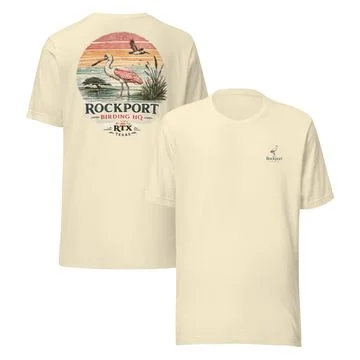
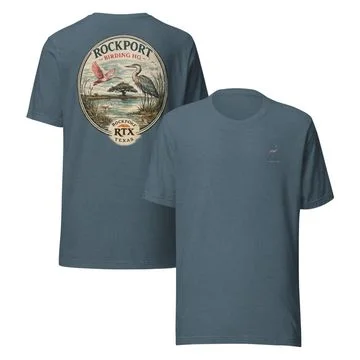
Wear
Rockport
Premium Bella+Canvas 3001.
Ships direct from Printful.
Ready to explore in person?
All self-guided tours are free. Just show up.