Native Plants · Lamar Peninsula
Red Bay
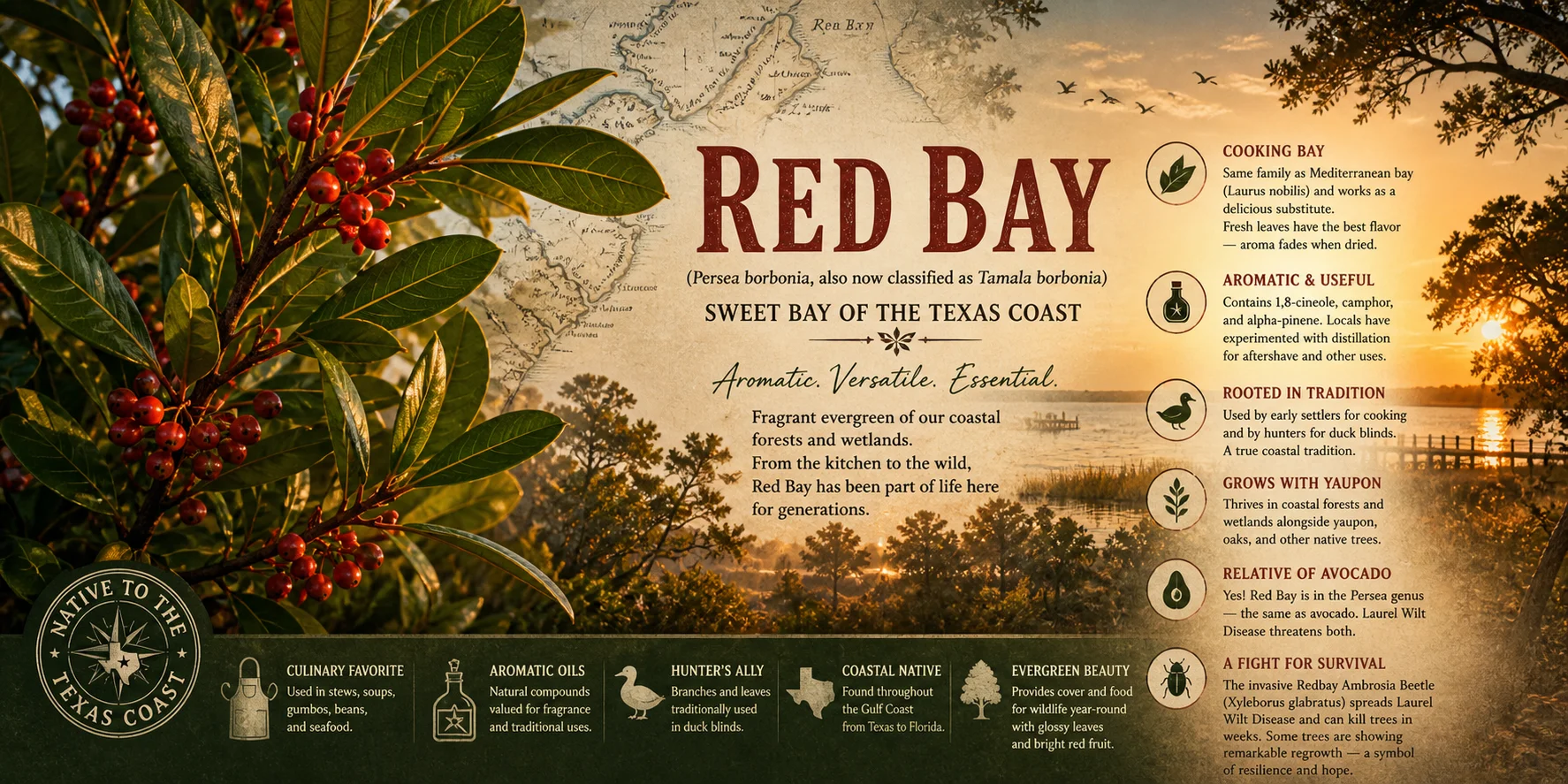
Persea borbonia — also classified as Tamala borbonia · Sweet Bay of the Texas Coast
Snap a leaf. Bring it to your nose. That deep, spiced, almost medicinal fragrance is one of the great sensory secrets of the Texas coast — and it's been hiding in plain sight along the Lamar Peninsula for thousands of years.
Quick Facts
The Leaf That Stops You Cold
Red Bay grows in dense, glossy thickets throughout the coastal forests of the Lamar Peninsula — almost always alongside Yaupon Holly. The two plants share the same moist, coastal habitat and have been companions on this shoreline for millennia.
Local duck hunters have long known Red Bay for another reason — the dense, pliable branches make excellent material for constructing duck blinds along Aransas Bay. It's one of those pieces of coastal folk knowledge that never makes it into field guides.
The Seminole and Creek peoples used Red Bay leaves as a natural insect repellent and brewed them as a tea to ease fevers and settle upset stomachs. Early settlers quickly adopted it as a local substitute for the Mediterranean bay leaf — the same aromatic family, growing right at their doorstep.
🍃 The Bay Leaf in Your Backyard
Red Bay belongs to the same plant family as the Mediterranean bay laurel (*Laurus nobilis*) used in kitchens worldwide — and its leaves work the same way. Break one open and the resemblance is unmistakable.
Use fresh leaves — this is important. Unlike imported dried bay leaves, Red Bay's aroma is strongest fresh and fades with drying. Add 2–3 fresh leaves early in a long simmer: stews, soups, braises, tomato sauces. Remove before serving.
Before Mediterranean bay laurel became widely available through trade, Red Bay was the bay leaf of the coastal Southeast. Early settlers and indigenous peoples used it in exactly that role for generations.
How to Use It
- ✓Pick fresh, healthy leaves — avoid damaged or yellowed ones
- ✓Crush lightly before adding to release the oils
- ✓Add at the start of cooking, not the end
- ✓Simmer at least 45 minutes to develop full flavor
- ✓Use 2–3 fresh leaves where a recipe calls for 1 dried bay leaf
- ✓Remove leaves before serving — same as traditional bay
- ✓Works in: stews, gumbos, braises, tomato sauce, rice dishes
Aromatic & Essential
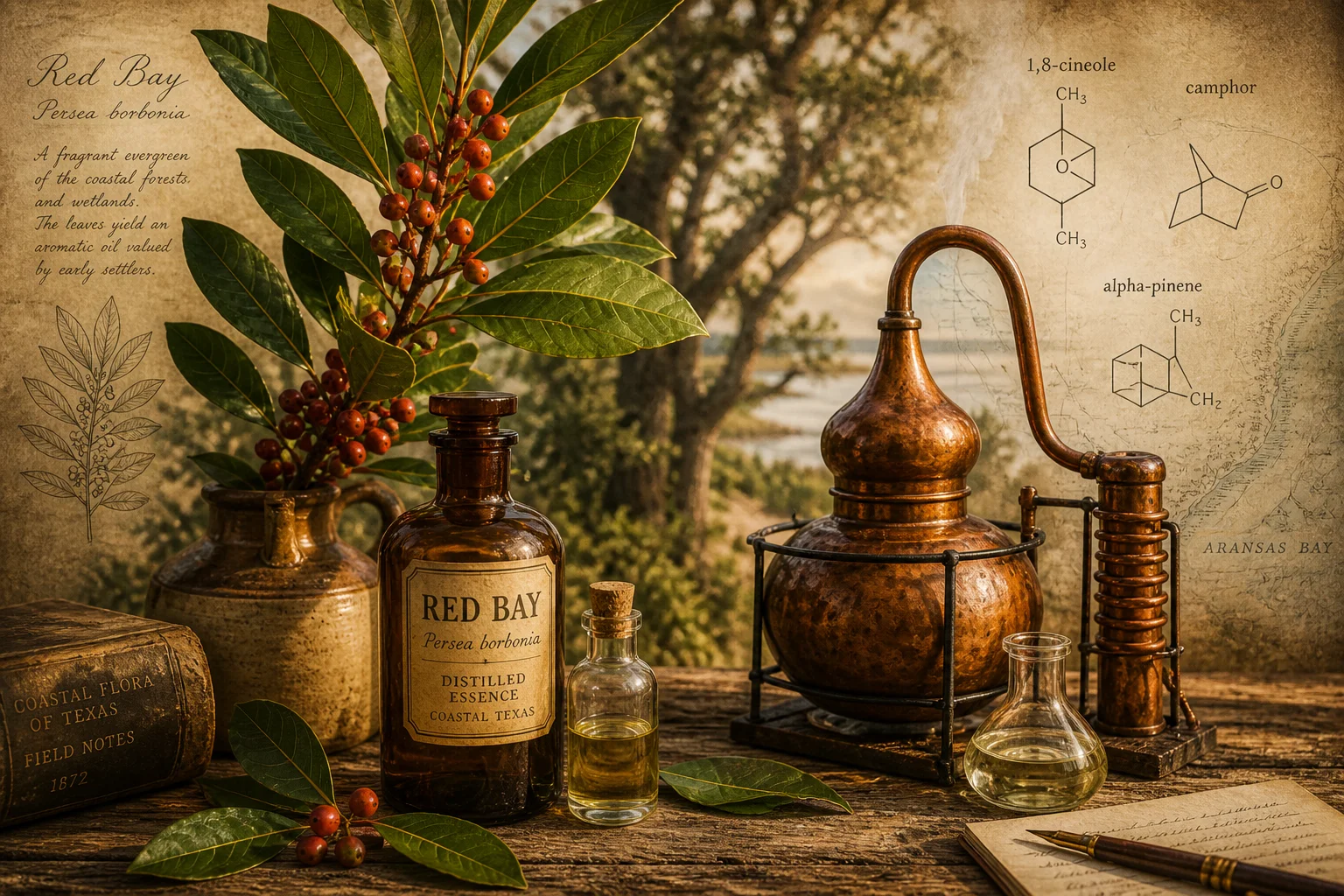
The fragrance of Red Bay comes from three primary aromatic compounds — 1,8-cineole (eucalyptol), camphor, and alpha-pinene — each contributing a different note to the complex, resinous smell that fills the air when you crush a leaf.
The leaves reach peak essential oil content (around 2.5–3%) in April and May, just before flowering — making spring the best time to experience the plant at its most aromatic.
These compounds have real utility: 1,8-cineole has documented bronchodilatory and anti-inflammatory properties; camphor is used widely in cosmetics and medicinals; alpha-pinene is antimicrobial. Local distillation experiments — like your friend's aftershave project — are tapping into chemistry that has genuine potential.
Peak Harvest
April–May, just before flowering. Morning picking when essential oils are most concentrated.
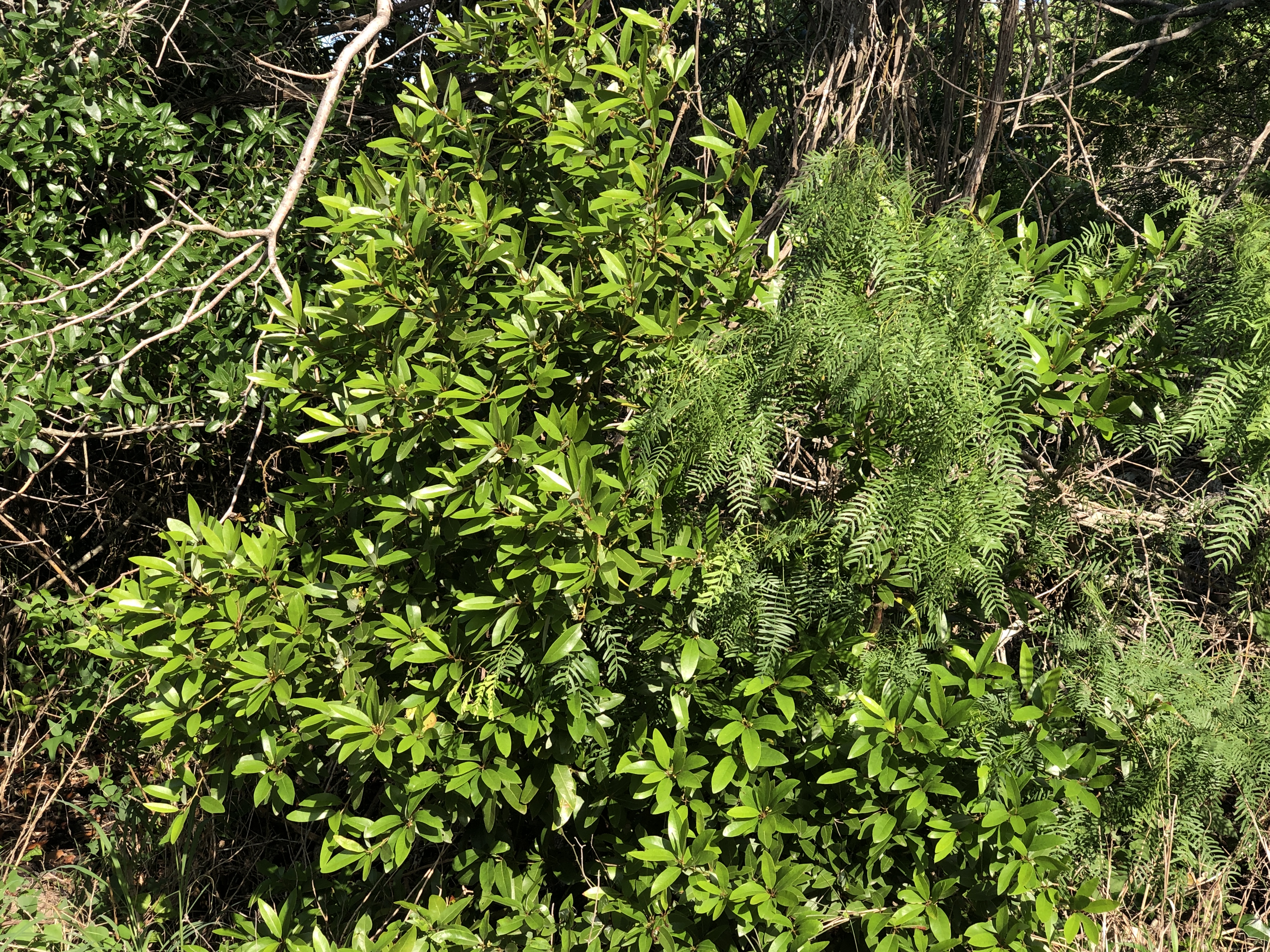
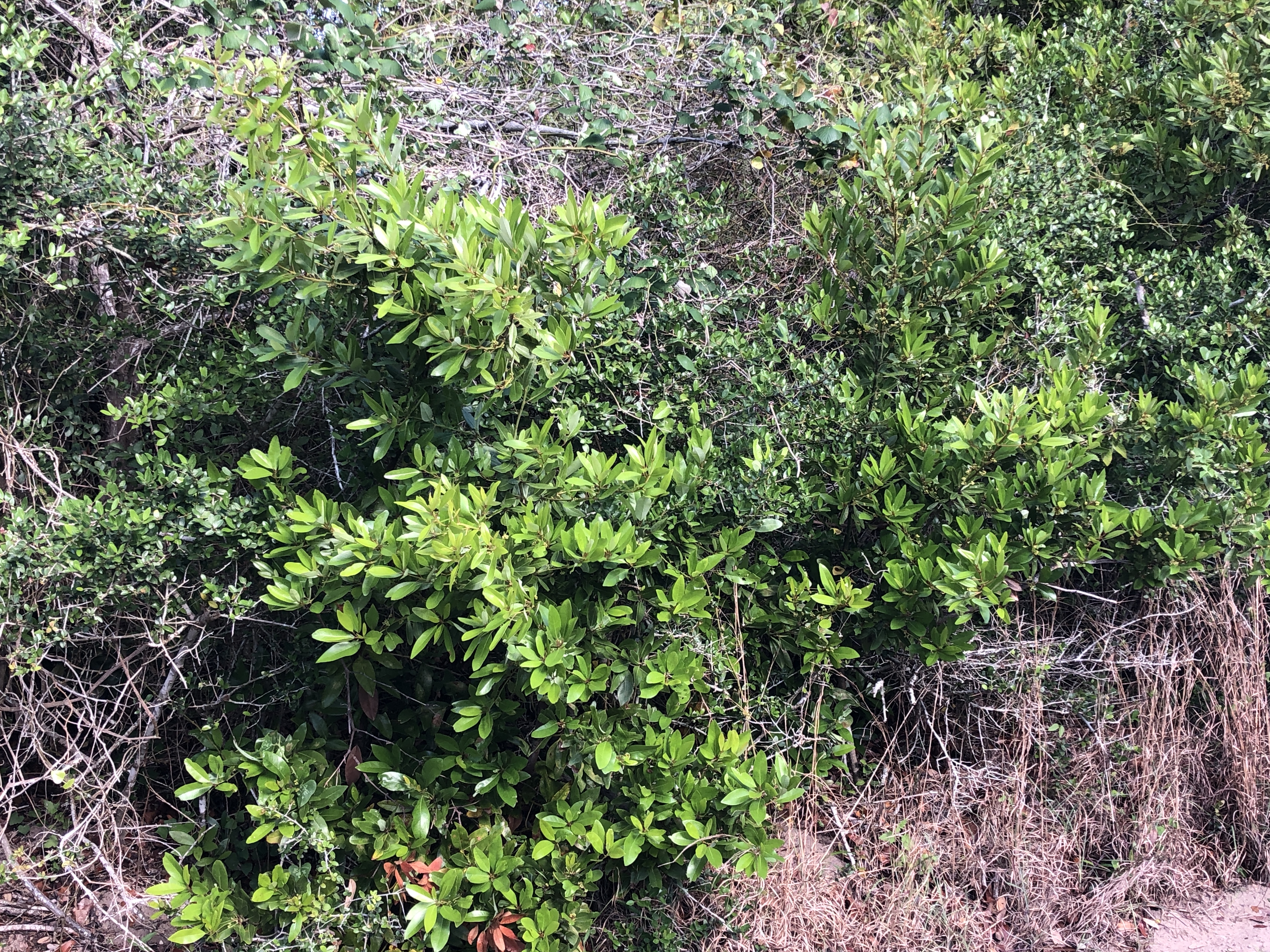
Red Bay growing in its natural coastal thicket habitat on the Lamar Peninsula — alongside ferns and the dense undergrowth typical of Aransas County's coastal forests.
Conservation Alert
A Fight for Survival — and a Comeback Story
The thriving Red Bay thickets you see on the Lamar Peninsula today are survivors. In 2002, an invasive beetle from Southeast Asia — the Redbay Ambrosia Beetle (Xyleborus glabratus) — arrived in Savannah, Georgia, likely in wooden shipping pallets.
The beetle bores into Red Bay wood and introduces a fungal pathogen called Laurel Wilt Disease (Raffaelea lauricola). The fungus clogs the tree's vascular system. Death follows within weeks. Hundreds of millions of Red Bay trees have been lost across the southeastern United States.
The beetle reached Texas in 2015, first confirmed in Hardin County. By 2024 it had been detected in 16 Texas counties. There is currently no cure for infected trees.
The plants you see growing here are survivors and resistant individuals — naturally selected by the outbreak. Researchers are actively propagating these resistant specimens, and resistant Red Bay varieties are in development. The comeback on the Lamar Peninsula is real, and it's a hopeful sign.
Note: Laurel Wilt also threatens avocado crops — Red Bay and avocado are in the same genus (Persea), making this an active agricultural concern as well.
Relative of Avocado
Red Bay (Persea borbonia) and avocado (Persea americana) share the same genus. Red Bay produces small, bird-dispersed berries — avocado's large fruit is unusual within the genus.
Palamedes Swallowtail Host
Red Bay is the primary larval host plant for the Palamedes Swallowtail butterfly — a large, striking species common on the Texas coast. No Red Bay, no Palamedes.
Wildlife Food Source
The small dark berries are eaten by songbirds, wild turkeys, bobwhite quail, and white-tailed deer — making Red Bay a keystone plant in the coastal thicket food web.
🗺️ Where to Find Red Bay on the Texas Coast
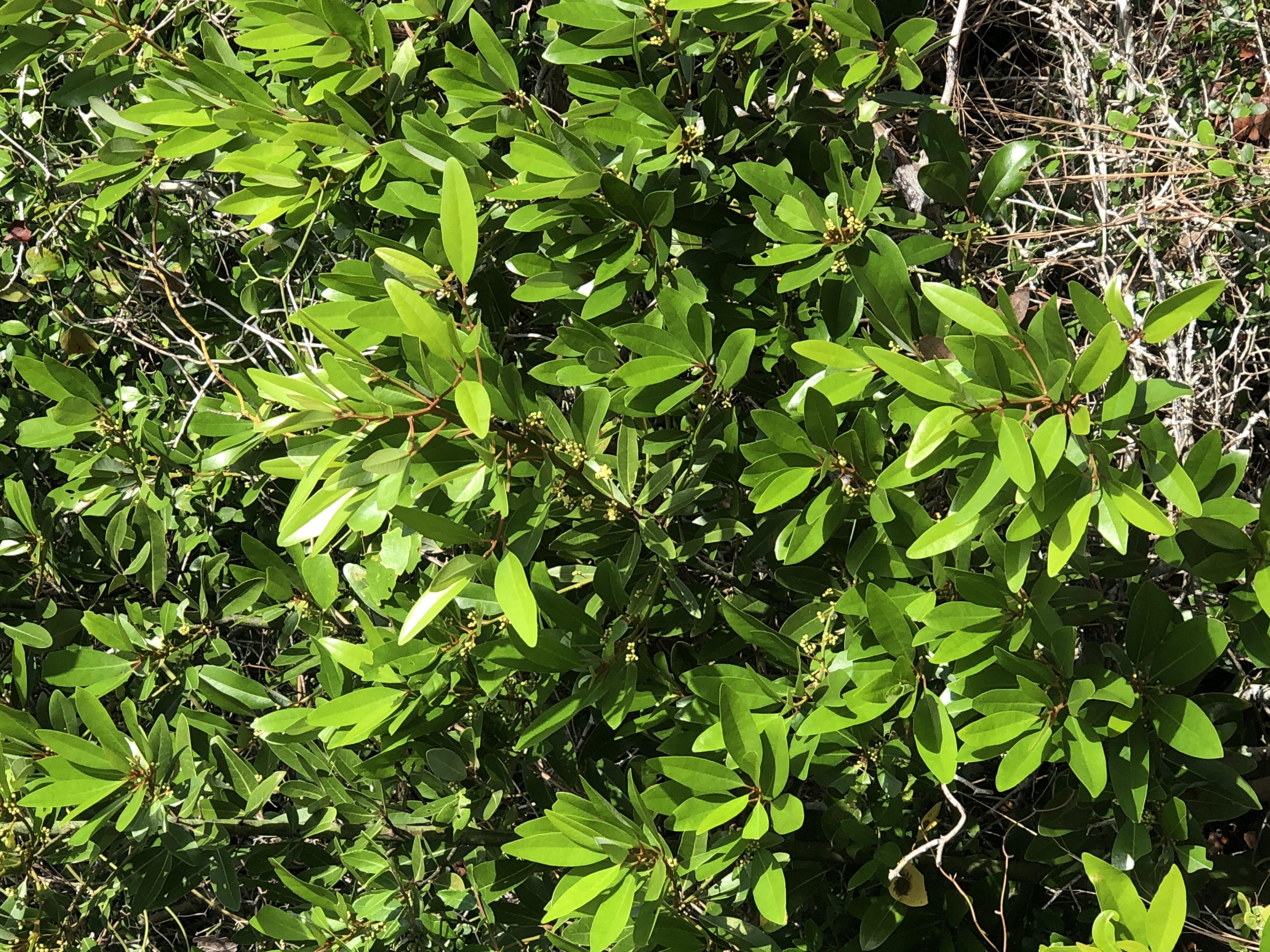
Red Bay grows throughout the coastal thickets of the Lamar Peninsula — look for it in the dense shrub zones alongside Yaupon Holly, especially in areas with moist, slightly acidic soil near the bay margins. It's an evergreen, so it's visible year-round. The glossy, oval leaves and spiced smell when crushed make it unmistakable once you know what you're looking for.