Texas Gulf Coast · Aransas Bay
Raptors of Rockport
Hunters from above. From the tiny American Kestrel hovering over a wildflower meadow to the Great Horned Owl ruling the night — the Texas coast hosts one of the most diverse raptor lineups in North America.
Why Rockport Is Raptor Country
Rockport and the Aransas Bay area sit at a powerful intersection of habitat types — open coastal prairie, live oak mottes, tidal marsh, open bay, and freshwater ponds. Each draws a different suite of predators. The same afternoon drive can produce an Osprey diving into the bay, a Kestrel hovering over a roadside meadow, and a Great Horned Owl flushing from a live oak at dusk.
The Central Flyway funnels millions of birds through this corridor each spring and fall — and where there are migrants, there are raptors following them. Rockport is one of the best places in Texas to see a wide variety of birds of prey in a single day.
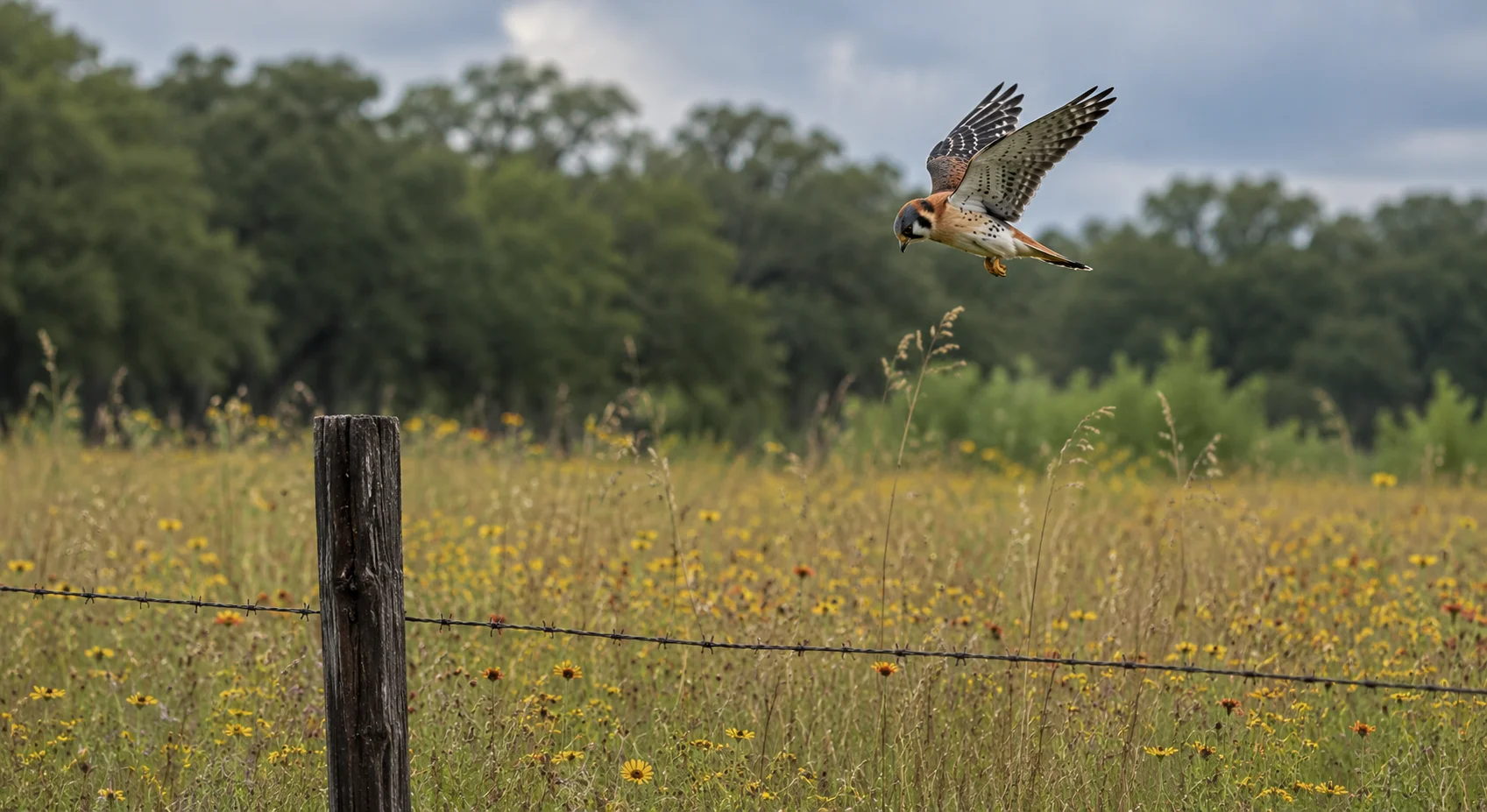
American Kestrel — America's smallest falcon, a winter fixture along Rockport's open roadsides
The Lineup — Smallest to Largest
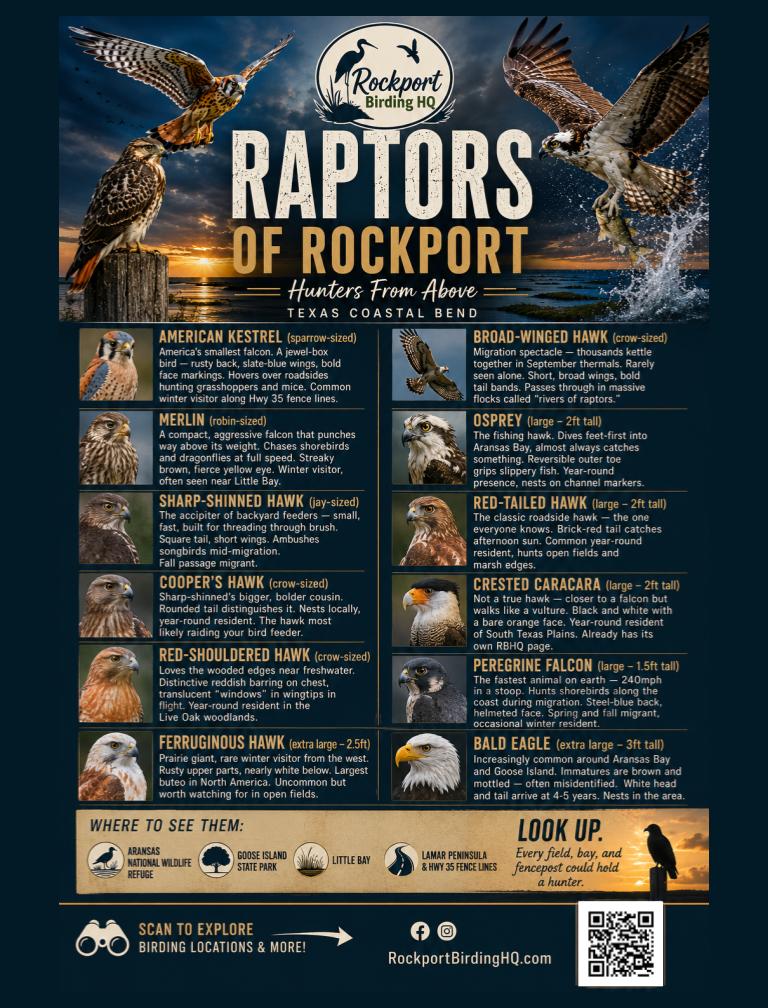
American Kestrel
Falco sparverius
Sparrow-sized · 9–12 in
America's smallest falcon and arguably its most colorful. The male's rusty back and slate-blue wings make it a jewel-box bird. Hovers over roadsides hunting grasshoppers and mice with mechanical precision. Watch fence lines along Hwy 35 in winter.
Merlin
Falco columbarius
Robin-sized · 10–13 in
A compact, aggressive falcon that punches way above its weight. Chases shorebirds and dragonflies at full speed with relentless determination. Streaky brown with a fierce yellow eye. Watch near Little Bay and the waterfront in winter.
Sharp-shinned Hawk
Accipiter striatus
Jay-sized · 10–14 in
The accipiter built for speed through dense brush. Small and fast with short rounded wings and a square tail. Ambushes songbirds mid-migration — the hawk most likely to cause a sudden panicked flush at your feeder. Fall passage migrant through Rockport.
Cooper's Hawk
Accipiter cooperii
Crow-sized · 14–20 in
Sharp-shinned's bigger, bolder cousin. The rounded tail (vs. square on Sharp-shin) is the key field mark. A year-round resident that nests locally in live oak mottes. Most likely the hawk raiding your backyard feeder — it flies like it owns the place.
Broad-winged Hawk
Buteo platypterus
Crow-sized · 13–17 in
A migration spectacle when seen in numbers — thousands kettle together in September thermals along the coast. Bold black-and-white tail bands and short broad wings. Passes through in massive flocks called rivers of raptors. Rarely seen alone.
Red-shouldered Hawk
Buteo lineatus
Crow-sized · 17–24 in
Loves wooded edges near freshwater. Distinctive reddish barring on the chest and translucent crescents in the wingtips visible in flight. A year-round resident of the Live Oak woodland corridors around Rockport and the Lamar Peninsula.
Red-tailed Hawk
Buteo jamaicensis
Large · 18–26 in
The classic roadside hawk — the one everyone knows. Brick-red tail catches the afternoon sun from a fence post or utility pole. The most common large hawk in North America and a year-round resident here. Hunts open fields, marsh edges, and roadsides.
Ferruginous Hawk
Buteo regalis
Extra large · 22–27 in
A prairie giant wandering east from its western home. Rusty upper parts and nearly white undersides make it stand out. The largest buteo in North America. Uncommon in Aransas County but worth watching for in open coastal grasslands during winter months.
Peregrine Falcon
Falco peregrinus
Large · 15–21 in
The fastest animal on earth — clocked at 240 mph in a stoop. Hunts shorebirds along the coast during migration with breathtaking aerial precision. Steel-blue back, helmeted face, long pointed wings. A spring and fall migrant along the Aransas Bay shoreline.
Osprey
Pandion haliaetus
Large · 21–23 in
The fishing hawk. Dives feet-first into Aransas Bay and almost always catches something — a reversible outer toe grips slippery fish like a vice. Year-round presence along the bay, nesting on channel markers and navigation buoys. One of Rockport's most reliably seen raptors.
Full Osprey Guide →Bald Eagle
Haliaeetus leucocephalus
Extra large · 28–38 in
Documented at Aransas National Wildlife Refuge, where a nesting pair has been recorded on the 9-mile driving loop. Immatures are brown and mottled — often misidentified — with the white head and tail arriving at age 4–5. A memorable sighting when one appears over the bay.
Crested Caracara
Caracara cheriway
Large · 19–23 in
Not a true hawk — closer to a falcon but walks like a vulture. Bold black-and-white with a bare orange-red face. A year-round resident of south Texas prairie and ranchland, regularly seen on fence posts and alongside vultures along Hwy 35.
Full Caracara Guide →Great Horned Owl
Bubo virginianus
Extra large · 18–25 in
The apex nocturnal predator of the Texas coast. Ear tufts, enormous orange eyes, and silent flight on wings that make no sound. Takes prey as large as skunks, herons, and other raptors. Listen for deep resonant hooting at dusk in the live oaks near Lamar. Juveniles have been spotted learning to fly near the Lamar Peninsula — large and fluffy, hawk-sized, with the mother watching silently from a distance.
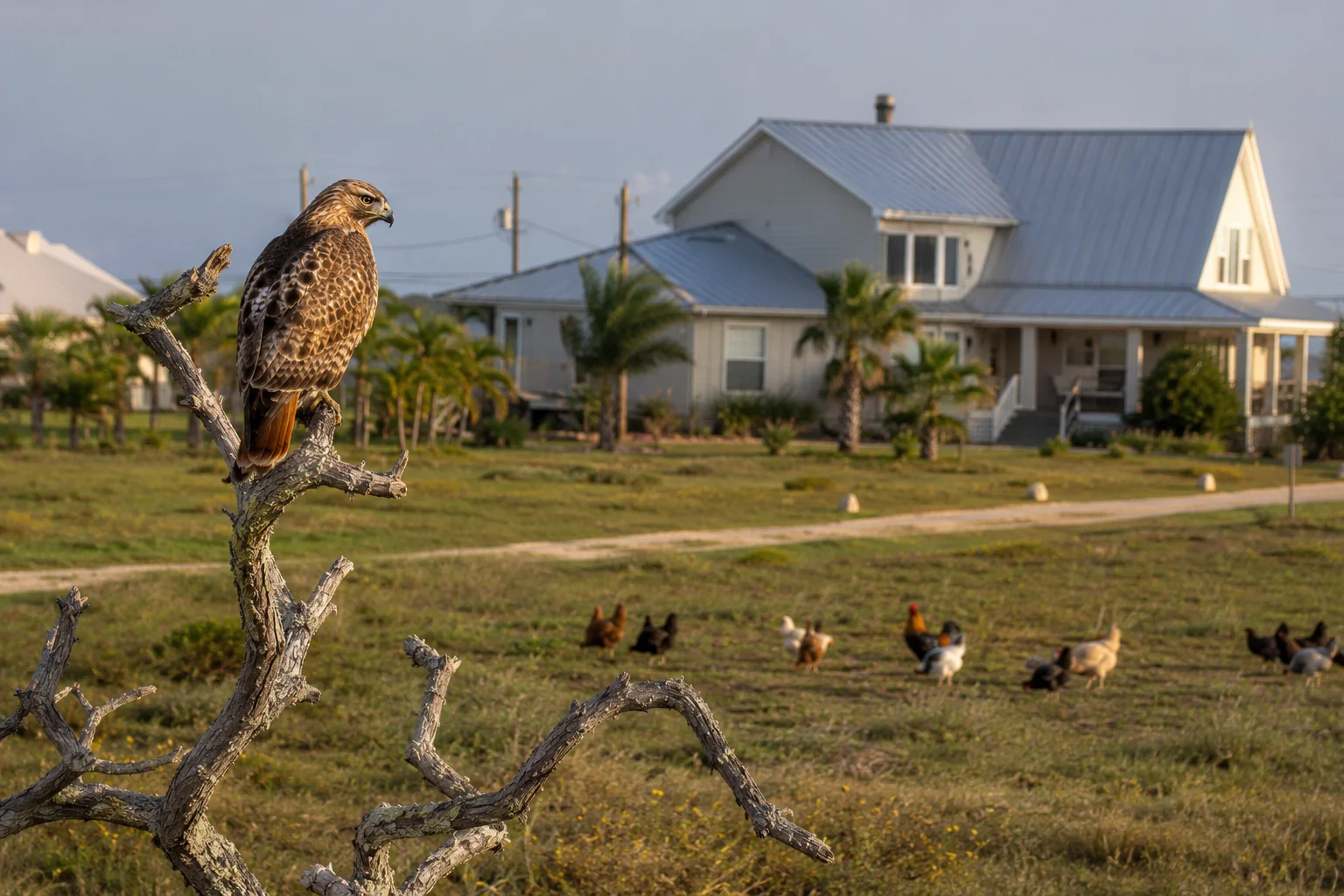
Red-tailed Hawks are year-round residents — scan utility poles and fence posts along any rural road
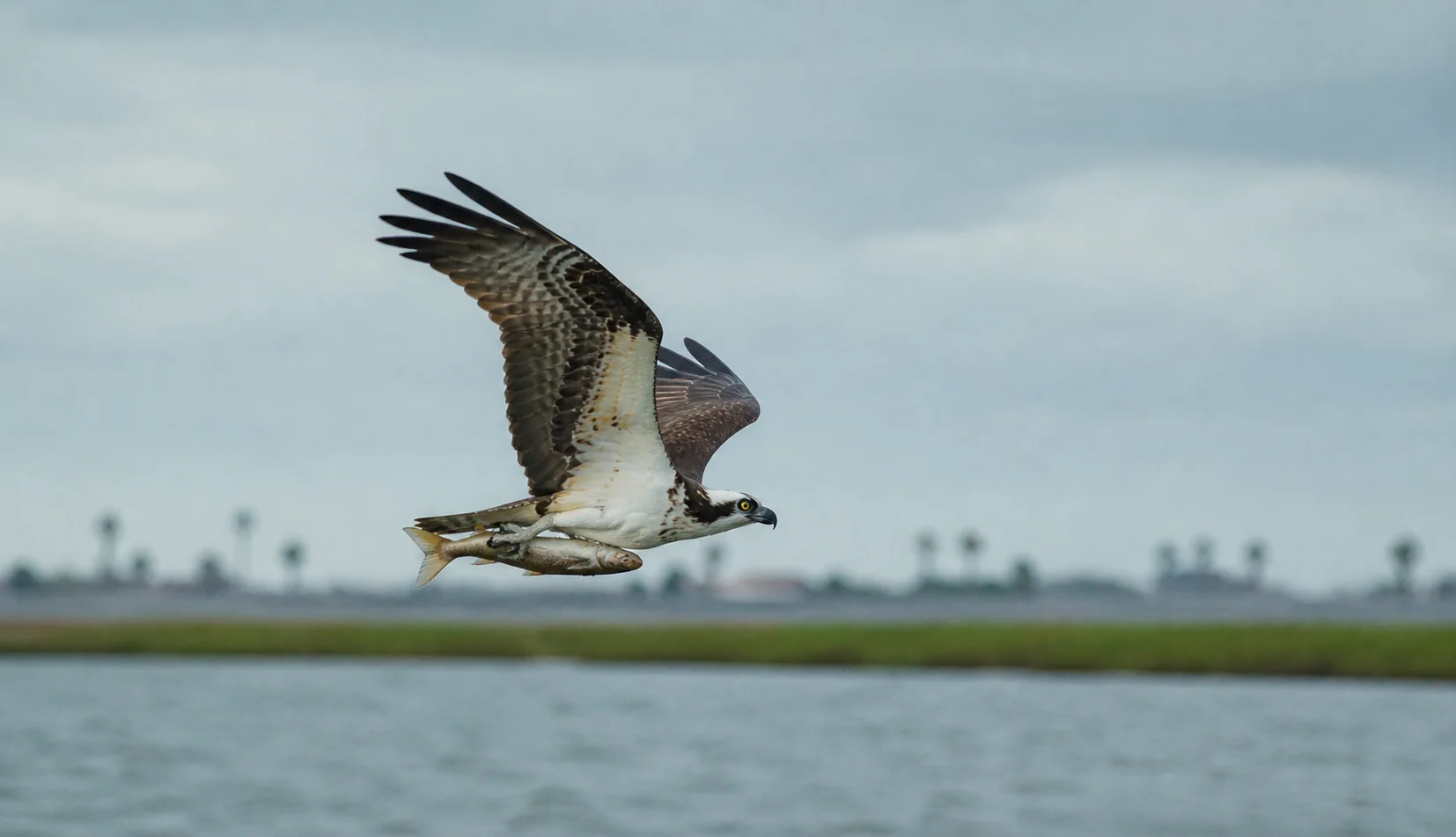
The Osprey — Rockport's Fishing Hawk
No raptor is more reliably spotted in Rockport than the Osprey. Year-round residents of Aransas Bay, they nest on channel markers and navigation buoys visible from shore. Watch for the dramatic feet-first plunge — they hit the water at speed and almost always emerge with a fish.
Full Osprey Guide →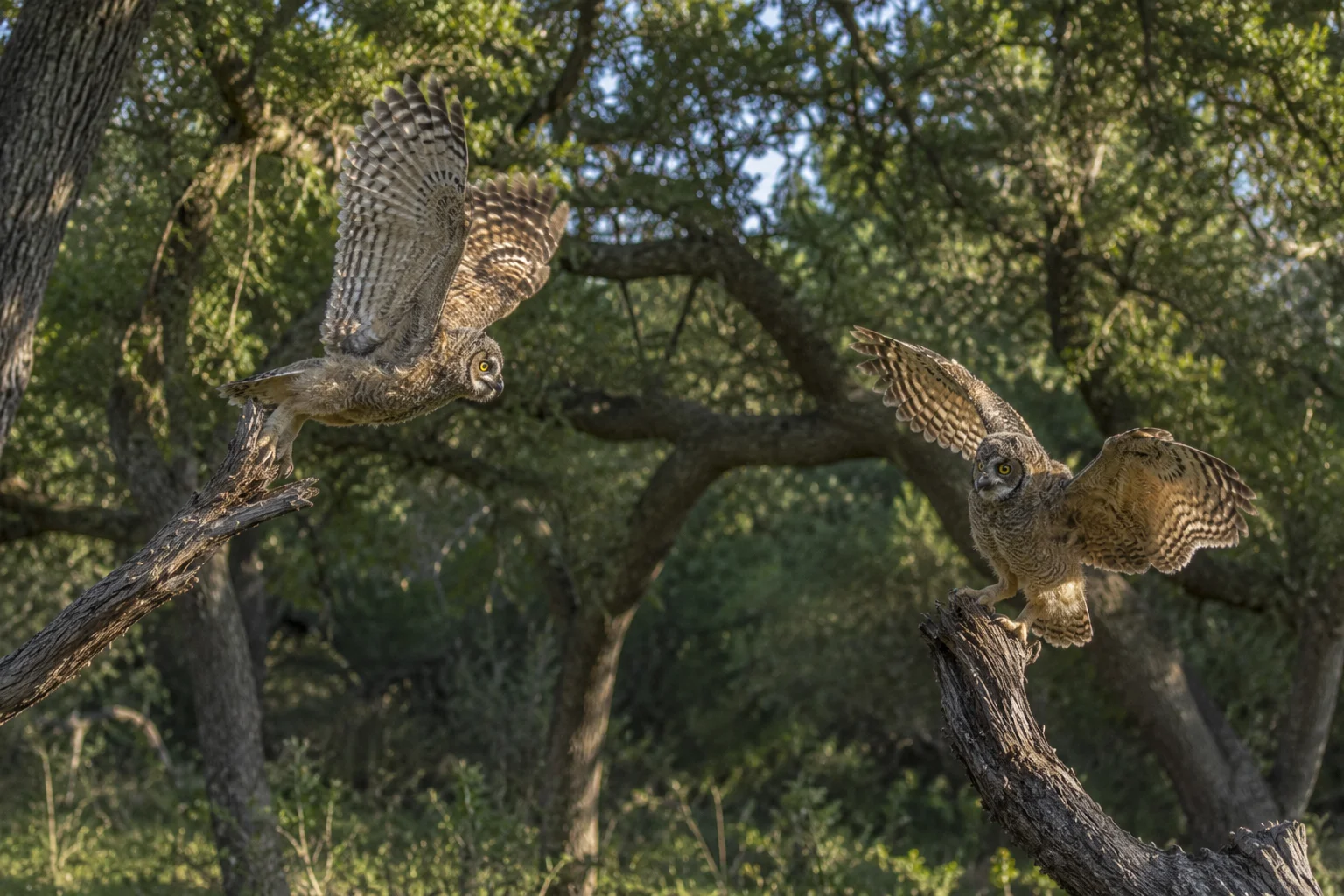
Great Horned Owl — silent flight, enormous presence. Listen for deep hooting in the live oaks near Lamar at dusk
The Great Horned Owl — Monster of the Night
The Great Horned Owl is the apex nocturnal predator of the Texas coast. Those prominent ear tufts are not ears — they're feather tufts used for communication and camouflage. The actual ears are asymmetrical openings on either side of the facial disc, giving this owl the ability to locate prey by sound alone in complete darkness.
It takes prey far larger than most people expect — skunks, herons, other raptors, and even domestic cats are documented prey items. The talons exert hundreds of pounds of pressure per square inch.
A pair of juveniles was recently spotted near the Lamar Peninsula learning to fly tree-to-tree — large, fluffy, and hawk-sized, with their mother watching silently from a distance. This species is here, nesting, and raising young in Rockport year-round.